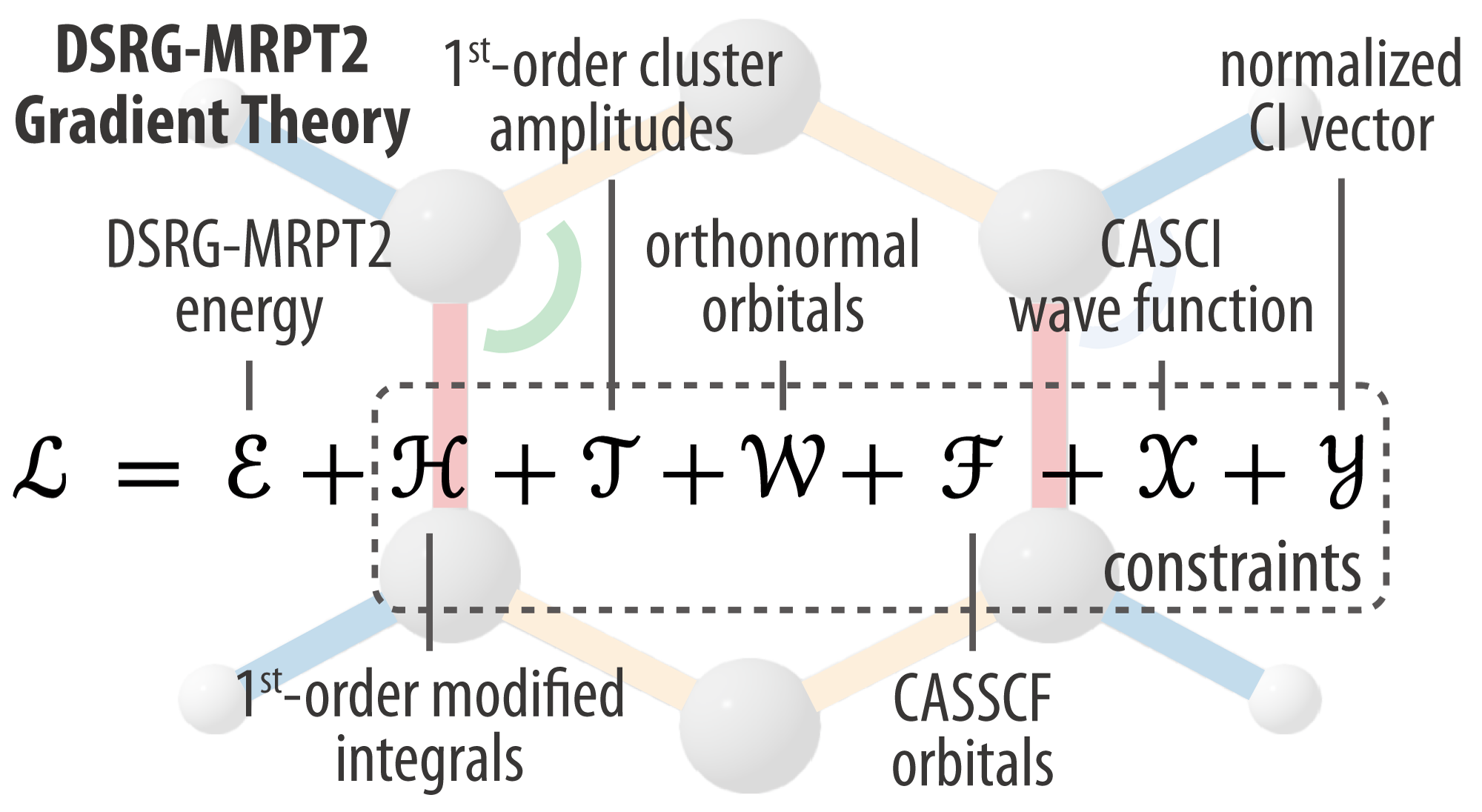
Analytic energy derivatives play a central role in modern electronic structure theory, enabling efficient geometry optimizations, vibrational frequency analyses, and molecular property calculations. Compared to numerical differentiation, analytic gradients are both more accurate and computationally efficient, avoiding the huge cost associated with finite-difference approaches.
We have derived analytic nuclear energy gradients for the second-order perturbation theory based on the driven similarity renormalization group (DSRG) [1], [2]. This development makes it possible to perform reliable geometry optimizations and explore potential energy surfaces within the DSRG framework, extending its applicability beyond single-point energy calculations.
In collaboration with Professor Wenjie Dou at Westlake University, we have developed analytic nuclear gradients for the stochastic resolution-of-identity CC2 method [3], [4]. By combining stochastic tensor factorization with efficient gradient theory, these works enable cost-effective structure optimizations and excited-state studies for large molecular systems while maintaining high accuracy.
An implementation of stochastic resolution of identity (sRI) approximation to CC2 oscillator strengths and ground state analytical gradients is presented. The essential four-index electron repulsion integral is contracted with a set of stochastic orbitals on the basis of the RI technique and the orbital energy difference in the denominators is decoupled by the Laplace transform. These lead to a significant scaling reduction from O(N5) to O(N3) for oscillator strengths with the number of basis functions, N. The scaling for gradients can also be reduced to O(N3) but this requires a large number of stochastic orbitals and causes a discernible loss of accuracy. Therefore, we provide an O(N4) version with better accuracy and smaller prefactor by adopting sRI partially. Such steep computational acceleration of nearly two or one order of magnitude is very attractive for large systems. This work is an extension to our previous implementations of sRI-CC2 ground and excited state energies and shows the feasibility of introducing sRI to CC2 properties beyond energies.
@article{Zhao2024d,author={Zhao, Chongxiao and Ou, Qi and Li, Chenyang and Dou, Wenjie},doi={10.1063/5.0270950},issn={0021-9606},journal={J. Chem. Phys.},month=jul,number={2},pages={024102},title={{Stochastic resolution of identity to CC2 for large systems: Oscillator strength and ground state gradient calculations}},url={https://pubs.aip.org/jcp/article/163/2/024102/3351824/Stochastic-resolution-of-identity-to-CC2-for-large},volume={163},year={2025},}
Excited-state gradients and derivative couplings are critical for simulating excited-state dynamics. However, their calculations are very expensive within the coupled-cluster framework due to the steep scaling. In this work, we present two implementations of stochastic resolution of identity to CC2 (sRI-CC2) for excited-state analytical gradients and derivative couplings. The first method employs sRI for both Coulomb and exchange terms, reducing the formal scaling to cubic. However, this method has significant stochastic noise. Consequently, we introduce a substitute, termed partial sRI-CC2, which applies sRI selectively to the exchange terms only. The partial sRI-CC2 shows a quartic scaling with a modest prefactor, rendering it a practical alternative. This work is an extension of our previous implementation of the sRI-CC2 method and provides essential ingredients for large-scale nonadiabatic dynamics.
@article{Zhao2025a,author={Zhao, Chongxiao and Li, Chenyang and Dou, Wenjie},doi={10.1063/5.0300647},issn={0021-9606},journal={J. Chem. Phys.},month=dec,number={23},pages={234101},publisher={AIP Publishing, LLC},title={{Stochastic resolution of identity to CC2 for large systems: Excited-state gradients and derivative couplings}},url={https://doi.org/10.1063/5.0300647 https://pubs.aip.org/jcp/article/163/23/234101/3374753/Stochastic-resolution-of-identity-to-CC2-for-large},volume={163},year={2025},}
We derive analytic energy gradients of the driven similarity renormalization group (DSRG) multireference second-order perturbation theory (MRPT2) using the method of Lagrange multipliers. In the Lagrangian, we impose constraints for a complete-active-space self-consistent-field reference wave function and the semicanonical orthonormal molecular orbitals. Solving for the associated Lagrange multipliers is found to share the same asymptotic scaling of a single DSRG-MRPT2 energy computation. A pilot implementation of the DSRG-MRPT2 analytic gradients is used to optimize the geometry of the singlet and triplet states of p-benzyne. The equilibrium bond lengths and angles are similar to those computed via other MRPT2s and Mukherjee’s multireference coupled cluster theory. An approximate DSRG-MRPT2 method that neglects the contributions of the three-body density cumulant is found to introduce negligible errors in the geometry of p-benzyne, lending itself to a promising low-cost approach for molecular geometry optimizations using large active spaces.
@article{Wang2021,archiveprefix={arXiv},arxivid={2109.14548},author={Wang, Shuhe and Li, Chenyang and Evangelista, Francesco A.},doi={10.1021/acs.jctc.1c00980},issn={1549-9618},journal={J. Chem. Theory Comput.},month=dec,number={12},pages={7666--7681},title={{Analytic Energy Gradients for the Driven Similarity Renormalization Group Multireference Second-Order Perturbation Theory}},url={https://pubs.acs.org/doi/10.1021/acs.jctc.1c00980},volume={17},year={2021},}
We derive and implement analytic energy gradients for the single-reference driven similarity renormalization group second-order perturbation theory (DSRG-PT2). The resulting equations possess an asymptotic scaling that is identical to that of the second-order Møller–Plesset perturbation theory (MP2), indicating that the exponential regularizer in the DSRG equations does not introduce formal difficulties in the gradient theory. We apply the DSRG-PT2 method to optimizing the geometries of 15 small molecules. The equilibrium bond lengths computed with DSRG-PT2 are found similar to those of MP2, yielding a mean absolute error of 0.0033 Å and a standard deviation of 0.0045 Å when compared with coupled cluster with singles, doubles, and perturbative triples.
@article{Wang:2019kf,author={Wang, Shuhe and Li, Chenyang and Evangelista, Francesco A},doi={10.1063/1.5100175},issn={0021-9606},journal={J. Chem. Phys.},month=jul,number={4},pages={044118},title={{Analytic gradients for the single-reference driven similarity renormalization group second-order perturbation theory}},url={http://aip.scitation.org/doi/10.1063/1.5100175},volume={151},year={2019},}