publications
The secret is comprised in three words – Work, Finish, Publish.
– Michael Faraday
2026
- Simultaneous Treatment of Electron Correlation and Spin-Orbit Coupling with State-Averaged Driven Similarity Renormalization Group Second-Order Perturbation TheoryMeng Wang and Chenyang Li*J. Chem. Theory Comput., Aug 2026
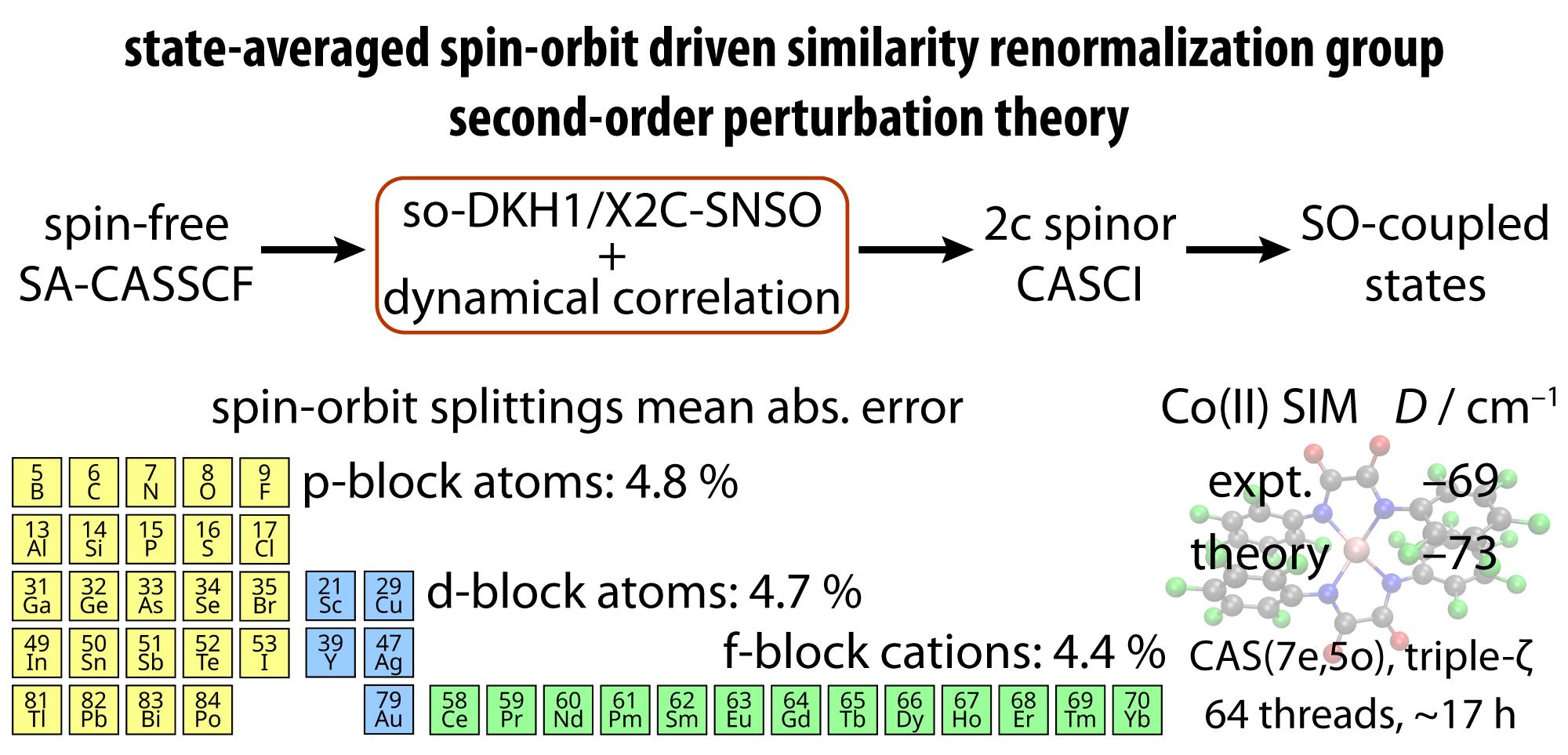
We report the state-averaged spin–orbit driven similarity renormalization group second-order perturbation theory (SA-SO-DSRG-PT2) for efficient computations of spin–orbit coupling (SOC) effects in multireference systems. This approach adopts a set of multiconfigurational reference states obtained with a spin-free relativistic Hamiltonian and introduces SOC during the perturbative treatment of dynamical correlation. Specifically, the zeroth-order Hamiltonian is defined from the spin-free Hamiltonian, while the remaining spin-free contributions and the spin-dependent Hamiltonian enter as first-order perturbations in the DSRG transformation. This formulation generates an SOC-containing SA-DSRG-PT2 effective Hamiltonian while largely preserving the computational cost of the conventional spin-free theory. Two spin-dependent Hamiltonians are examined: the first-order Douglas–Kroll–Hess spin–orbit Hamiltonian with mean-field approximated two-electron contributions and the spin-dependent part of the one-electron X2C Hamiltonian with the screened-nuclear spin–orbit approximation. Benchmarks on main-group atoms and diatomic molecules, transition-metal elements, trivalent lanthanide cations, and actinide dioxide cations show consistent accuracy across the periodic table for both spin-dependent Hamiltonians. Applications to Co(II) single-ion magnets, including systems described with up to 1790 basis functions, further highlight the promise of SA-SO-DSRG-PT2 for efficient SOC calculations in large open-shell molecules.
@article{Wang2026, author = {Wang, Meng and Li, Chenyang}, doi = {10.1021/acs.jctc.6c01381}, issn = {1549-9618}, journal = {J. Chem. Theory Comput.}, month = aug, title = {{Simultaneous Treatment of Electron Correlation and Spin-Orbit Coupling with State-Averaged Driven Similarity Renormalization Group Second-Order Perturbation Theory}}, url = {https://pubs.acs.org/jctcce/article/doi/10.1021/acs.jctc.6c01381}, year = {2026}, } - Enantioselective synthesis and characterization of [m.n]paracyclophanesYilu Wen, Yaqi Yao, Yujun Zhong, Chenyang Li*, and Changgui Zhao*Chem. Sci., Aug 2026
[m.n]Paracyclophanes ([m.n]PCPs) are widely used in asymmetric catalysis, energy materials, and π-stacked polymers. To date, however, most studies have focused on [2.2]PCPs. The atroposelective synthesis and structural characterization of [m.n]PCPs with variable ansa chain lengths remain underexplored. In this study, we report an N-heterocyclic carbene-catalyzed enantioselective macrocyclization. This method enables the efficient construction of a diverse array of [m.n]PCPs with excellent enantioselectivities. A comprehensive investigation was conducted, including ring strain energy calculations, aromatic interaction energy analysis, racemization barrier measurements, local strain visualization, and systematic geometric analysis. These studies provide detailed insights into the relationship between the macrocyclic structure and properties. The synthetic utility of [m.n]PCPs is demonstrated by a [6.5]PCP-derived thiourea organocatalyst that effectively promotes the asymmetric amination reaction.
@article{Wen2026, author = {Wen, Yilu and Yao, Yaqi and Zhong, Yujun and Li, Chenyang and Zhao, Changgui}, doi = {10.1039/D6SC05207J}, issn = {2041-6520}, journal = {Chem. Sci.}, month = aug, publisher = {Royal Society of Chemistry}, title = {{Enantioselective synthesis and characterization of [m.n]paracyclophanes}}, url = {https://pubs.rsc.org/sc/article/doi/10.1039/d6sc05207j}, year = {2026}, } - Towards quantitative computations of exchange coupling constants in transition-metal complexes via multireference driven similarity renormalization groupZiyu Hu and Chenyang Li*Inorg. Chem., Mar 2026
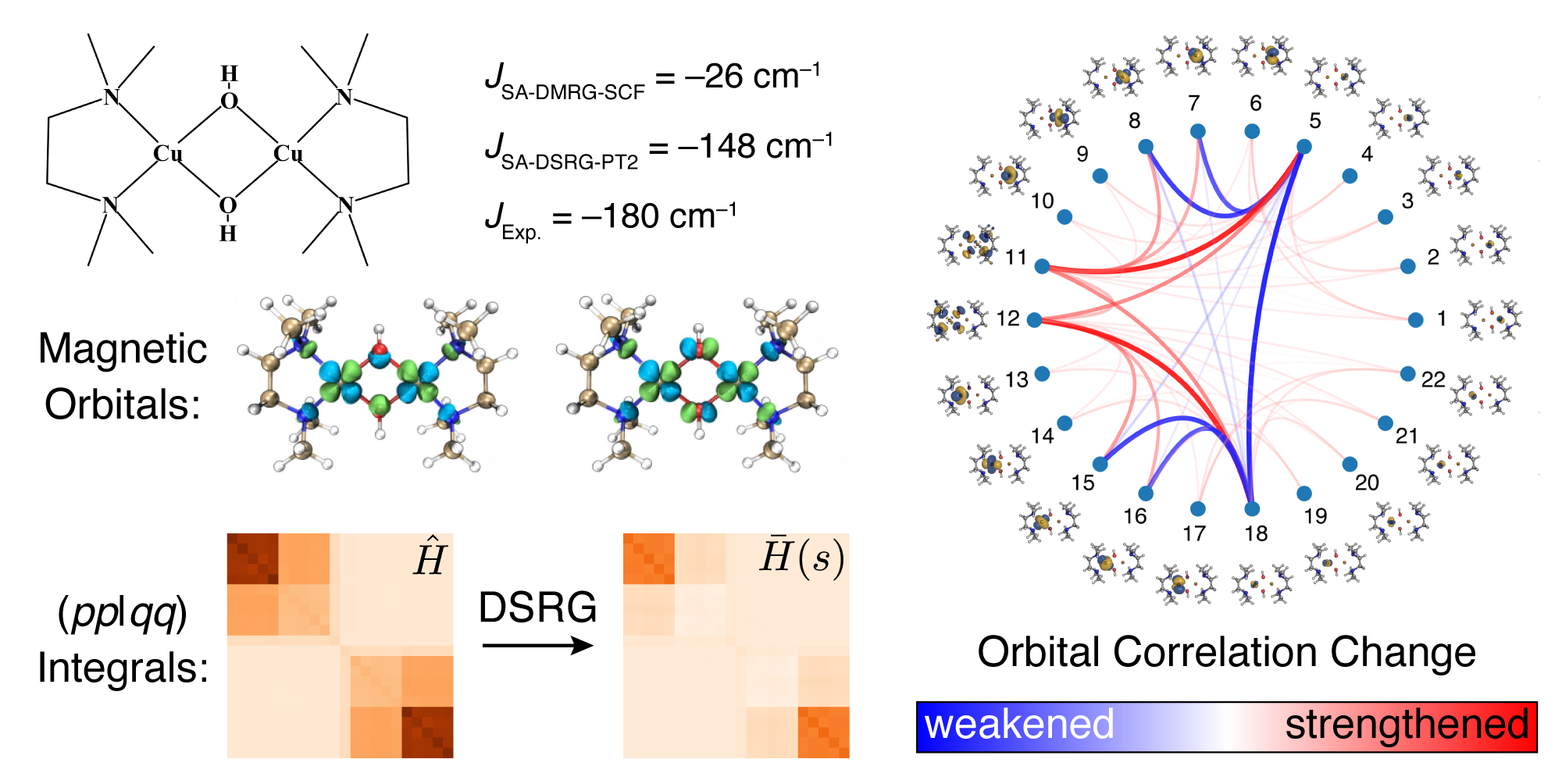
The accurate prediction of magnetic exchange coupling constants (J) in transition-metal complexes remains challenging for electronic structure theory. In this work, we demonstrate that the state-averaged driven similarity renormalization group second-order perturbation theory (SA-DSRG-PT2), combined with the density matrix renormalization group, provides quantitative J values on a set of 21 3d bimetallic complexes with a focus on dicopper species. Active orbitals are systematically identified using the atomic valence active space approach, ensuring a consistent inclusion of metal 3d and 4d shells, and the ligand orbitals involved in superexchange pathways. Analysis of the SA-DSRG-PT2 effective Hamiltonians indicates that the reduction of on-site Coulomb repulsion is the primary origin of the improved exchange couplings. In addition, we adopt the orbital mutual correlation plot as an intuitive tool to visualize exchange pathways, allowing direct identifications of metal-metal and metal-ligand correlations and their modulation by dynamical correlation. These results establish SA-DSRG- PT2 as a robust and practical multireference approach for studying magnetic interactions in transition-metal complexes.
@article{Hu2026,
  author = {Hu, Ziyu and Li, Chenyang},
  doi = {10.1021/acs.inorgchem.5c05829},
  issn = {0020-1669},
  journal = {Inorg. Chem.},
  month = mar,
  number = {13},
  pages = {7186--7196},
  title = {{Towards quantitative computations of exchange coupling constants in transition-metal complexes via multireference driven similarity renormalization group}},
  url = {https://pubs.acs.org/doi/10.1021/acs.inorgchem.5c05829},
  volume = {65},
  year = {2026},
}


2025
- Stochastic resolution of identity to CC2 for large systems: Excited-state gradients and derivative couplingsChongxiao Zhao, Chenyang Li*, and Wenjie Dou*J. Chem. Phys., Dec 2025
Excited-state gradients and derivative couplings are critical for simulating excited-state dynamics. However, their calculations are very expensive within the coupled-cluster framework due to the steep scaling. In this work, we present two implementations of stochastic resolution of identity to CC2 (sRI-CC2) for excited-state analytical gradients and derivative couplings. The first method employs sRI for both Coulomb and exchange terms, reducing the formal scaling to cubic. However, this method has significant stochastic noise. Consequently, we introduce a substitute, termed partial sRI-CC2, which applies sRI selectively to the exchange terms only. The partial sRI-CC2 shows a quartic scaling with a modest prefactor, rendering it a practical alternative. This work is an extension of our previous implementation of the sRI-CC2 method and provides essential ingredients for large-scale nonadiabatic dynamics.
@article{Zhao2025a, author = {Zhao, Chongxiao and Li, Chenyang and Dou, Wenjie}, doi = {10.1063/5.0300647}, issn = {0021-9606}, journal = {J. Chem. Phys.}, month = dec, number = {23}, pages = {234101}, publisher = {AIP Publishing, LLC}, title = {{Stochastic resolution of identity to CC2 for large systems: Excited-state gradients and derivative couplings}}, url = {https://doi.org/10.1063/5.0300647 https://pubs.aip.org/jcp/article/163/23/234101/3374753/Stochastic-resolution-of-identity-to-CC2-for-large}, volume = {163}, year = {2025}, } - Stochastic resolution of identity to CC2 for large systems: Oscillator strength and ground state gradient calculationsChongxiao Zhao, Qi Ou*, Chenyang Li*, and Wenjie Dou*J. Chem. Phys., Jul 2025
An implementation of stochastic resolution of identity (sRI) approximation to CC2 oscillator strengths and ground state analytical gradients is presented. The essential four-index electron repulsion integral is contracted with a set of stochastic orbitals on the basis of the RI technique and the orbital energy difference in the denominators is decoupled by the Laplace transform. These lead to a significant scaling reduction from O(N5) to O(N3) for oscillator strengths with the number of basis functions, N. The scaling for gradients can also be reduced to O(N3) but this requires a large number of stochastic orbitals and causes a discernible loss of accuracy. Therefore, we provide an O(N4) version with better accuracy and smaller prefactor by adopting sRI partially. Such steep computational acceleration of nearly two or one order of magnitude is very attractive for large systems. This work is an extension to our previous implementations of sRI-CC2 ground and excited state energies and shows the feasibility of introducing sRI to CC2 properties beyond energies.
@article{Zhao2024d, author = {Zhao, Chongxiao and Ou, Qi and Li, Chenyang and Dou, Wenjie}, doi = {10.1063/5.0270950}, issn = {0021-9606}, journal = {J. Chem. Phys.}, month = jul, number = {2}, pages = {024102}, title = {{Stochastic resolution of identity to CC2 for large systems: Oscillator strength and ground state gradient calculations}}, url = {https://pubs.aip.org/jcp/article/163/2/024102/3351824/Stochastic-resolution-of-identity-to-CC2-for-large}, volume = {163}, year = {2025}, } - Driven Similarity Renormalization Group with a Large Active Space: Applications to Oligoacenes, Zeaxanthin, and Chromium DimerChenyang Li*, Xiaoxue Wang, Huanchen Zhai*, and Wei-Hai FangJ. Chem. Theory Comput., Jun 2025
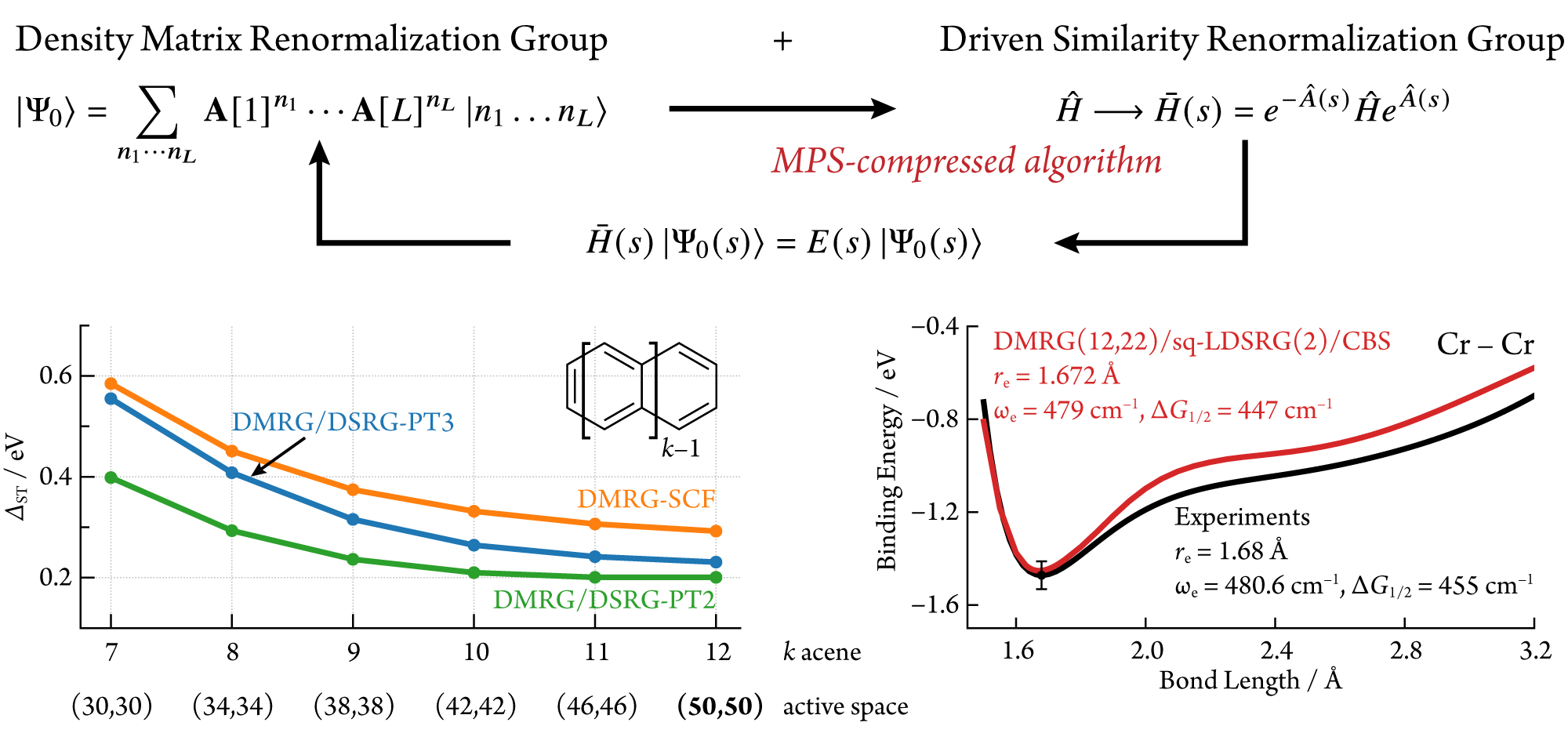
We present a new implementation of the driven similarity renormalization group (DSRG) based on a density matrix renormalization group (DMRG) reference. The explicit build of high-order reduced density matrices is avoided by forming matrix-product-state compressed intermediates. This algorithm facilitates the application of DSRG second- and third-order perturbation theories to dodecacene with an active space of 50 electrons in 50 orbitals. This active space appears the largest employed to date within the framework of internally contracted multireference formalism. The DMRG-DSRG approach is applied to several challenging systems, including the singlet-triplet gaps (ΔST) of oligoacenes ranging from naphthalene to dodecacene, the vertical excitation energies of zeaxanthin, and the ground-state potential energy curve (PEC) of Cr2 molecule. Our best estimate for the vertical ΔST of dodecacene is 0.22 eV, showing an excellent agreement with that of the linearized adiabatic connection method (0.24 eV). For zeaxanthin, all DSRG schemes suggest the order of 2 1Ag– < 1 1Bu+ < 1 1Bu– for excited states. Both the equilibrium and the shoulder regions of the Cr2 PEC are reasonably reproduced by the linearized DSRG with one- and two-body operators.
@article{Li2025, archiveprefix = {arXiv}, arxivid = {2503.01299}, author = {Li, Chenyang and Wang, Xiaoxue and Zhai, Huanchen and Fang, Wei-Hai}, doi = {10.1021/acs.jctc.5c00322}, issn = {1549-9618}, journal = {J. Chem. Theory Comput.}, month = jun, number = {11}, pages = {5445--5456}, title = {{Driven Similarity Renormalization Group with a Large Active Space: Applications to Oligoacenes, Zeaxanthin, and Chromium Dimer}}, url = {http://arxiv.org/abs/2503.01299 https://pubs.acs.org/doi/10.1021/acs.jctc.5c00322}, volume = {21}, year = {2025}, } - A Cost-Effective Treatment of Spin–Orbit Couplings in the State-Averaged Driven Similarity Renormalization Group Second-Order Perturbation TheoryMeng Wang and Chenyang Li*Molecules, May 2025
We present an economical approach to treat spin–orbit coupling (SOC) in the state-averaged driven similarity renormalization group second-order perturbation theory (SA-DSRG-PT2). The electron correlation is first introduced by forming the SA-DSRG-PT2 dressed spin-free Hamiltonian. This Hamiltonian is then augmented with the Breit–Pauli Hamiltonian and diagonalized using spin-pure reference states to obtain the SOC-corrected energy spectrum. The spin–orbit mean-field approximation is also assumed to reduce the cost associated with the two-electron spin–orbit integrals. The resulting method is termed BP1-SA-DSRG-PT2c, and it possesses the same computational scaling as the non-relativistic counterpart, where only the one- and two-body density cumulants are required to obtain the vertical transition energy. The accuracy of BP1-SA-DSRG-PT2c is assessed on a few atoms and small molecules, including main-group diatomic molecules, transition-metal atoms, and actinide dioxide cations. Numerical results suggest that BP1-SA-DSRG-PT2c performs comparably to other internally contracted multireference perturbation theories with SOC treated using the state interaction scheme.
@article{Wang2025a, author = {Wang, Meng and Li, Chenyang}, doi = {10.3390/molecules30092082}, issn = {1420-3049}, journal = {Molecules}, month = may, number = {9}, pages = {2082}, title = {{A Cost-Effective Treatment of Spin–Orbit Couplings in the State-Averaged Driven Similarity Renormalization Group Second-Order Perturbation Theory}}, url = {https://www.mdpi.com/1420-3049/30/9/2082}, volume = {30}, year = {2025}, } - Diastereo- and Enantioselective Catalytic Kinetic Resolution of 2-Substituted 3-Nitro-2 H -chromenesYanhao Su, Chaochao Xie, Ziyu Hu, Guofu Zi, Chenyang Li*, and Guohua Hou*Org. Lett., Mar 2025
An unprecedented catalytic kinetic resolution of 2-substituted 3-nitro-2H-chromenes via Rh-catalyzed asymmetric hydrogenation has been developed to simultaneously produce a variety of syn-chiral 2-substituted 3-nitro-2H-chromanes containing vicinal stereogenic centers with excellent diastero- and enantioselectivities [diastereomeric ratio (dr) of >99:1 and up to 99.9% enantiomeric excess (ee)] and recovered chiral 2-substituted 3-nitro-2H-chromenes with 90–99.9% ee in high yields, respectively, achieving excellent kinetic selectivity factors of up to 1057. Moreover, in addition to syn-chiral 2-substituted 3-nitro-2H-chromanes, this new approach provides concise, atom-economical, and straightforward access to anti-chiral 2-substituted 3-nitro-2H-chromanes and a mammalian target of rapamycin (mTOR) inhibitor, (R)-DHM25.
@article{Su2025, author = {Su, Yanhao and Xie, Chaochao and Hu, Ziyu and Zi, Guofu and Li, Chenyang and Hou, Guohua}, doi = {10.1021/acs.orglett.5c00903}, issn = {1523-7060}, journal = {Org. Lett.}, month = mar, number = {12}, pages = {3095--3100}, title = {{Diastereo- and Enantioselective Catalytic Kinetic Resolution of 2-Substituted 3-Nitro-2 H -chromenes}}, url = {https://pubs.acs.org/doi/10.1021/acs.orglett.5c00903}, volume = {27}, year = {2025}, } - PerspectiveChallenges and opportunities in electronic structure theoryChenyang Li, Ganglong Cui*, and Xiangjian Shen*Sci. Sin. Chim., Mar 2025
@article{Li2024g,
  author = {Li, Chenyang and Cui, Ganglong and Shen, Xiangjian},
  doi = {10.1360/SSC-2024-0222},
  issn = {1674-7224},
  journal = {Sci. Sin. Chim.},
  month = mar,
  number = {3},
  pages = {550--564},
  title = {{Challenges and opportunities in electronic structure theory}},
  url = {https://engine.scichina.com/doi/10.1360/SSC-2024-0222 https://www.sciengine.com/doi/10.1360/SSC-2024-0222},
  volume = {55},
  year = {2025},
}



2024
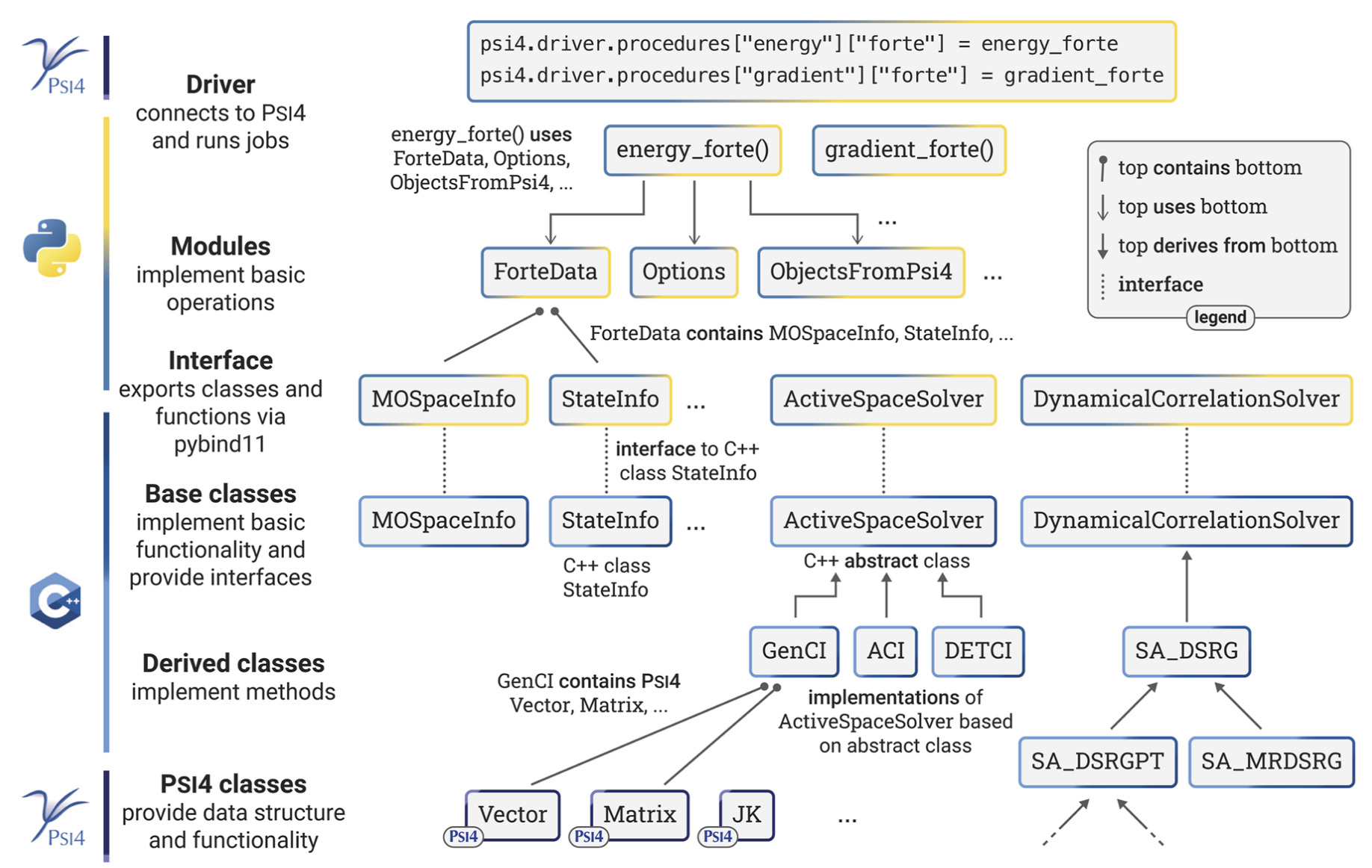
- Forte: A suite of advanced multireference quantum chemistry methodsFrancesco A. Evangelista*, Chenyang Li, Prakash Verma, Kevin P. Hannon, Jeffrey B. Schriber, Tianyuan Zhang, Chenxi Cai, Shuhe Wang, Nan He, and 8 more authorsJ. Chem. Phys., Aug 2024
Forte is an open-source library specialized in multireference electronic structure theories for molecular systems and the rapid prototyping of new methods. This paper gives an overview of the capabilities of Forte, its software architecture, and examples of applications enabled by the methods it implements.
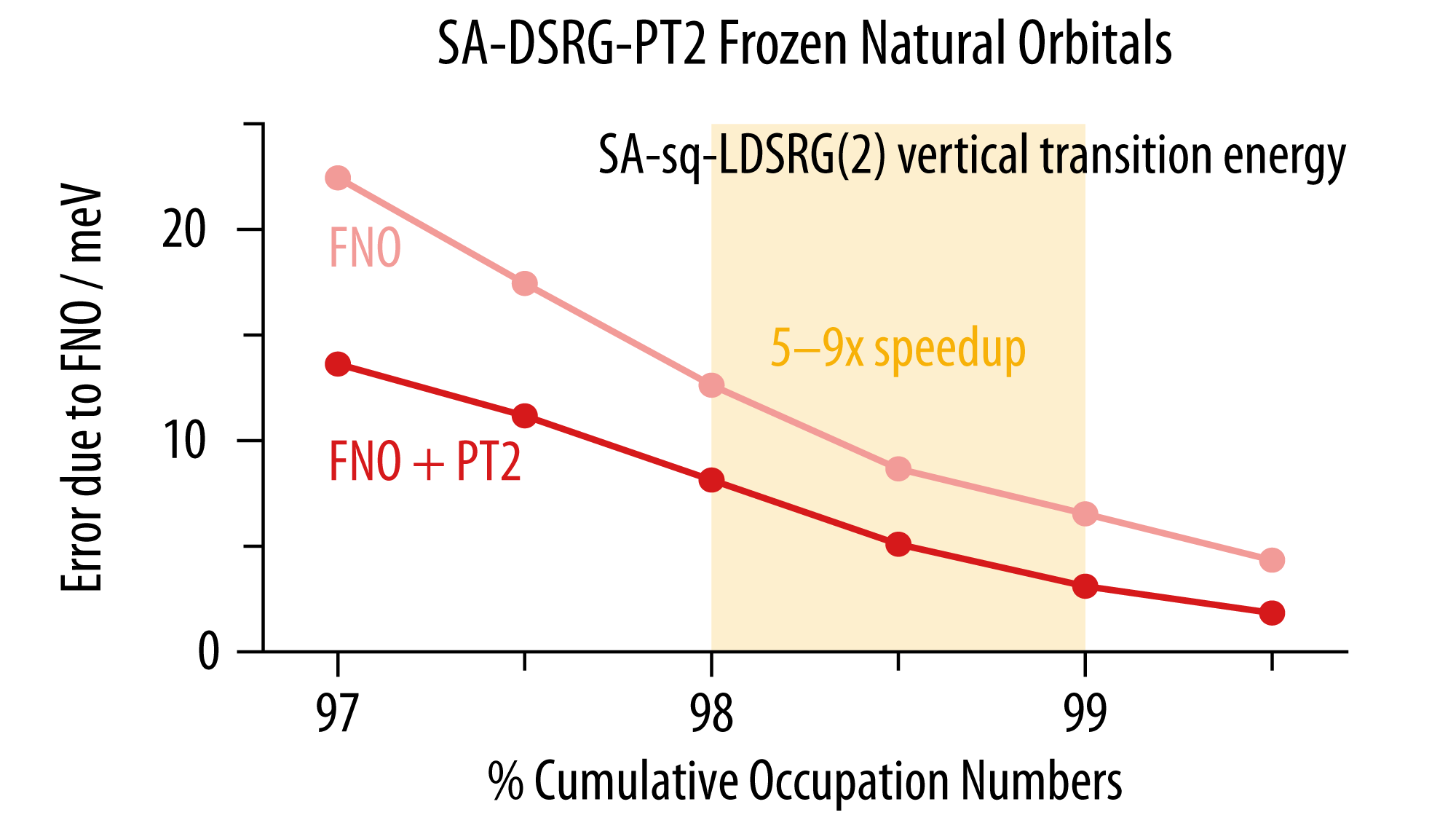
@article{Evangelista2024, author = {Evangelista, Francesco A. and Li, Chenyang and Verma, Prakash and Hannon, Kevin P. and Schriber, Jeffrey B. and Zhang, Tianyuan and Cai, Chenxi and Wang, Shuhe and He, Nan and Stair, Nicholas H. and Huang, Meng and Huang, Renke and Misiewicz, Jonathon P. and Li, Shuhang and Marin, Kevin and Zhao, Zijun and Burns, Lori A.}, doi = {10.1063/5.0216512}, issn = {0021-9606}, journal = {J. Chem. Phys.}, month = aug, number = {6}, pages = {062502}, publisher = {AIP Publishing, LLC}, title = {{Forte: A suite of advanced multireference quantum chemistry methods}}, url = {https://doi.org/10.1063/5.0216512 https://pubs.aip.org/jcp/article/161/6/062502/3307579/Forte-A-suite-of-advanced-multireference-quantum}, volume = {161}, year = {2024}, } - Frozen Natural Orbitals for the State-Averaged Driven Similarity Renormalization GroupChenyang Li*, Shuxian Mao, Renke Huang, and Francesco A. EvangelistaJ. Chem. Theory Comput., May 2024
We present a reduced-cost implementation of the state-averaged driven similarity renormalization group (SA-DSRG) based on the frozen natural orbital (FNO) approach. The natural orbitals (NOs) are obtained by diagonalizing the one-body reduced density matrix from SA-DSRG second-order perturbation theory (SA-DSRG-PT2). We consider three criteria to truncate the virtual NOs for the subsequent electron correlation treatment beyond SA-DSRG-PT2. An additive second-order correction is applied to the SA-DSRG Hamiltonian to reintroduce correlation effects from the discarded orbitals. The FNO SA-DSRG method is benchmarked on 35 small organic molecules in the QUEST database. When keeping 98–99% of the cumulative occupation numbers, the mean absolute error in the vertical transition energies due to FNO is less than 0.01 eV. Using the same FNO threshold, we observe a speedup of 9 times compared to the conventional SA-DSRG implementation for nickel carbonyl with a quadruple-ζ basis set. The FNO approach enables nonperturbative SA-DSRG computations on chloroiron corrole [FeCl(C19H11N4)] with more than 1000 basis functions, surpassing the current limit of a conventional implementation.
@article{Li2024c, author = {Li, Chenyang and Mao, Shuxian and Huang, Renke and Evangelista, Francesco A.}, doi = {10.1021/acs.jctc.4c00152}, issn = {1549-9618}, journal = {J. Chem. Theory Comput.}, month = may, number = {10}, pages = {4170--4181}, title = {{Frozen Natural Orbitals for the State-Averaged Driven Similarity Renormalization Group}}, url = {https://pubs.acs.org/doi/10.1021/acs.jctc.4c00152}, volume = {20}, year = {2024}, } - N-Heterocyclic carbene-catalyzed enantioselective synthesis of planar-chiral cyclophanes via dynamic kinetic resolutionJiayan Li, Ziyang Dong, Yang Chen, Zhanhui Yang, Xinen Yan, Meng Wang, Chenyang Li*, and Changgui Zhao*Nat. Commun., Mar 2024
Planar-chiral cyclophanes have gained considerable concerns for drug discovery due to their unique conformational strain and 3D structure. However, the enantioselective synthesis of planar-chiral cyclophanes is a long-standing challenge for the synthetic community. We herein describe an N-heterocyclic carbene (NHC)-catalyzed asymmetric construction of planar-chiral cyclophanes. This transformation occurs through a dynamic kinetic resolution (DKR) process to convert racemic substrates into planar-chiral macrocycle scaffolds in good to high yields with high to excellent enantioselectivities. The ansa chain length and aromatic ring substituent size is crucial to achieve the DKR approach. Controlled experiments and DFT calculations were performed to clarify the DKR process.
@article{Li2024a, author = {Li, Jiayan and Dong, Ziyang and Chen, Yang and Yang, Zhanhui and Yan, Xinen and Wang, Meng and Li, Chenyang and Zhao, Changgui}, doi = {10.1038/s41467-024-46376-8}, issn = {2041-1723}, journal = {Nat. Commun.}, month = mar, number = {1}, pages = {2338}, publisher = {Springer US}, title = {{N-Heterocyclic carbene-catalyzed enantioselective synthesis of planar-chiral cyclophanes via dynamic kinetic resolution}}, url = {https://www.nature.com/articles/s41467-024-46376-8}, volume = {15}, year = {2024}, } - N-Heterocyclic Carbene-Catalyzed Highly Enantioselective Macrolactonization to Access Planar-Chiral MacrocyclesJiaming Wang, Meng Wang, Yilu Wen, Peng Teng, Chenyang Li*, and Changgui Zhao*Org. Lett., Feb 2024
An N-heterocyclic carbene (NHC)-catalyzed atroposelective macrolactonization has been disclosed. This approach affords planar-chiral macrocycles in high yields with excellent enantioselectivities over a broad substrate scope. Controlled experiments suggest that the enantioselectivity might arise from the cation–n interaction between the acyl azolium and the electron-rich moiety in the substrate. This mechanism is supported by density functional theory calculations, which also suggest an important π–π interaction in stabilizing the transition state.
@article{Wang2024,
  author = {Wang, Jiaming and Wang, Meng and Wen, Yilu and Teng, Peng and Li, Chenyang and Zhao, Changgui},
  doi = {10.1021/acs.orglett.3c04200},
  issn = {1523-7060},
  journal = {Org. Lett.},
  month = feb,
  number = {5},
  pages = {1040--1045},
  title = {{N-Heterocyclic Carbene-Catalyzed Highly Enantioselective Macrolactonization to Access Planar-Chiral Macrocycles}},
  url = {https://pubs.acs.org/doi/10.1021/acs.orglett.3c04200},
  volume = {26},
  year = {2024},
}



2023
- Leveraging Small-Scale Quantum Computers with Unitarily Downfolded HamiltoniansRenke Huang, Chenyang Li, and Francesco A. Evangelista*PRX Quantum, Apr 2023
In this work, we propose a quantum unitary downfolding formalism based on the driven similarity renormalization group (QDSRG) that may be combined with quantum algorithms for both noisy and fault-tolerant hardware. The QDSRG is a classical polynomially-scaling downfolding method that avoids the evaluation of costly three- and higher-body reduced density matrices while retaining the accuracy of classical multireference many-body theories. We calibrate and test the QDSRG on several challenging chemical problems and propose a strategy for avoiding classical exponential-scaling steps in the QDSRG scheme. We report QDSRG computations of two chemical systems using the variational quantum eigensolver on IBM quantum devices: i) the dissociation curve of H2 using a quintuple-ζ basis and ii) the bicyclobutane isomerization reaction to trans-butadiene, demonstrating the reduction of problems that require several hundred qubits to a single qubit. Our work shows that the QDSRG is a viable approach to leverage near-term quantum devices for the accurate estimation of molecular properties.
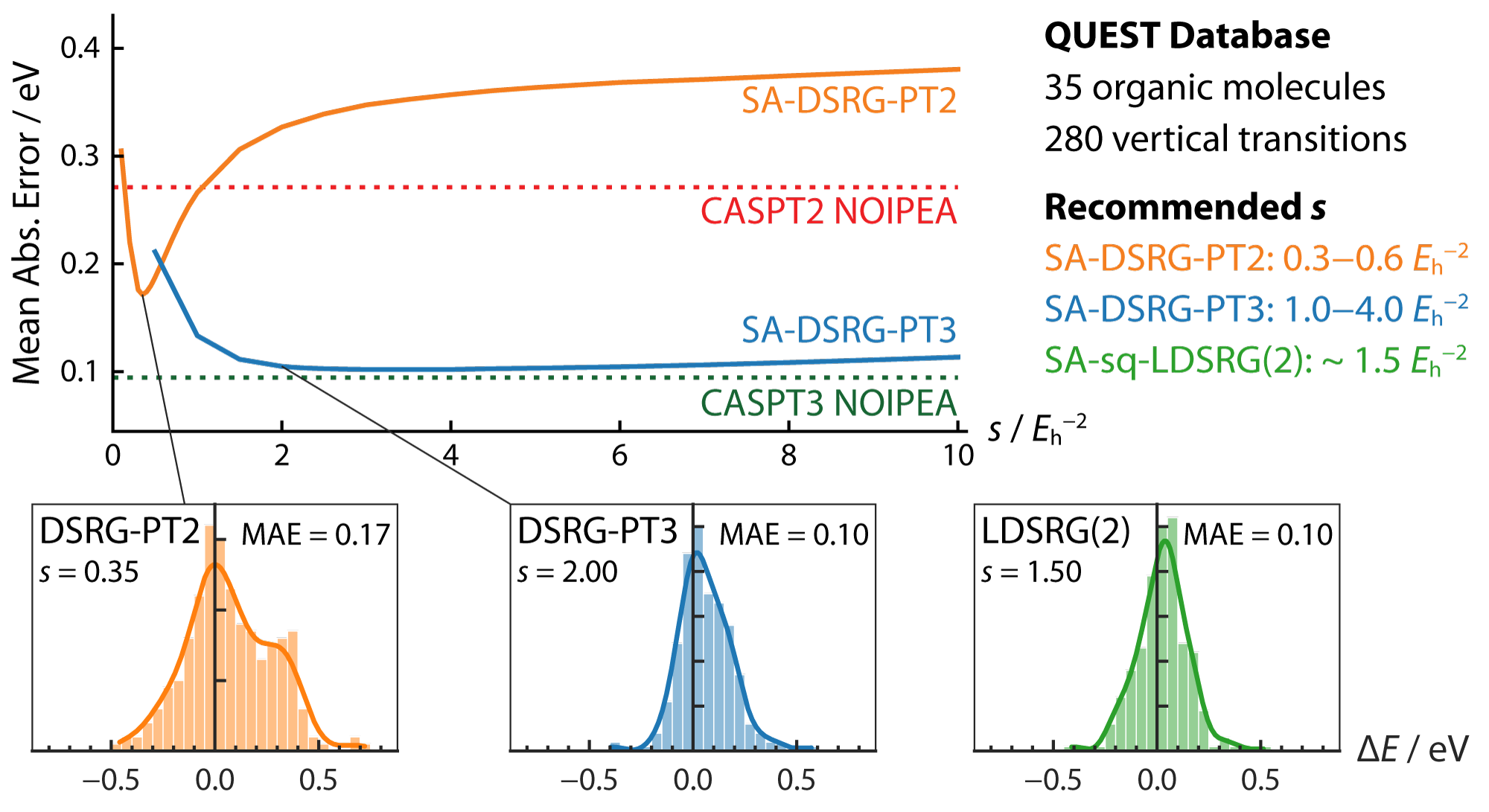
@article{Huang2023, archiveprefix = {arXiv}, arxivid = {2208.08591}, author = {Huang, Renke and Li, Chenyang and Evangelista, Francesco A.}, doi = {10.1103/PRXQuantum.4.020313}, issn = {2691-3399}, journal = {PRX Quantum}, keywords = {doi:10.1103/PRXQuantum.4.020313 url:https://doi.or}, month = apr, number = {2}, pages = {020313}, publisher = {American Physical Society}, title = {{Leveraging Small-Scale Quantum Computers with Unitarily Downfolded Hamiltonians}}, url = {http://arxiv.org/abs/2208.08591 https://link.aps.org/doi/10.1103/PRXQuantum.4.020313}, volume = {4}, year = {2023}, } - Assessment of State-Averaged Driven Similarity Renormalization Group on Vertical Excitation Energies: Optimal Flow Parameters and Applications to NucleobasesMeng Wang, Wei-Hai Fang, and Chenyang Li*J. Chem. Theory Comput., Jan 2023
We present a comprehensive excited-state benchmark for the state-averaged (SA) driven similarity renormalization group (DSRG) [Li, C.; Evangelista, F. A. J. Chem. Phys. 2018, 148, 124106]. Following the QUEST database [Véril, M.; Scemama, A.; Caffarel, M.; Lipparini, F.; Boggio-Pasqua, M.; Jacquemin, D.; Loos, P.-F. Wiley Interdiscip. Rev. Comput. Mol. Sci. 2021, 11, e1517], 280 vertical transition energies of 35 medium-sized molecules are computed using the SA-DSRG derived second- and third-order perturbation theories (PT2/PT3) along with a nonperturbative approach [sq-LDSRG(2)]. Comparing to the theoretical best estimates, the optimal flow parameter is found to be 0.35 and 2.0 Eh–2 for SA-DSRG-PT2 and SA-DSRG-PT3, respectively. For SA-sq-LDSRG(2), a flow parameter of 1.5 Eh–2 provides converged equations without compromising the accuracy. We then assess the accuracy of the SA-DSRG hierarchy using these parameters. The SA-DSRG-PT2 scheme outperforms the level-shifted CASPT2 by 0.10 eV in mean absolute error (MAE), yet this accuracy is slightly inferior than that of CASPT2 with the ionization-potential–electron-affinity shift. Both SA-DSRG-PT3 and SA-sq-LDSRG(2) yield a MAE of 0.10 eV, which is comparable to that of CASPT3 (0.09 eV). Finally, we compute vertical excitation energies of several low-lying singlet states of nucleobases. The SA-sq-LDSRG(2) approach provides highly accurate results for π → π* excitations, while n → π* transitions are better described by SA-DSRG-PT3.
@article{Wang2023,
  author = {Wang, Meng and Fang, Wei-Hai and Li, Chenyang},
  doi = {10.1021/acs.jctc.2c00966},
  issn = {1549-9618},
  journal = {J. Chem. Theory Comput.},
  month = jan,
  number = {1},
  pages = {122--136},
  title = {{Assessment of State-Averaged Driven Similarity Renormalization Group on Vertical Excitation Energies: Optimal Flow Parameters and Applications to Nucleobases}},
  url = {https://pubs.acs.org/doi/10.1021/acs.jctc.2c00966},
  volume = {19},
  year = {2023},
}


2022
- Second-Order Active-Space Embedding TheoryNan He, Chenyang Li, and Francesco A. Evangelista*J. Chem. Theory Comput., Mar 2022
Quantum embedding schemes are a promising way to extend multireference computations to large molecules with strong correlation effects localized on a small number of atoms. This work introduces a second-order active-space embedding theory [ASET(2)] which improves upon mean-field frozen embedding by treating fragment–environment interactions via an approximate canonical transformation. The canonical transformation employed in ASET(2) is formulated using the driven similarity renormalization group. The ASET(2) scheme is benchmarked on the N═N bond dissociation in pentyldiazene, the S0 to S1 excitation in 1-octene, and the interaction energy of the O2–benzene complex. The ASET(2) explicit treatment of fragment–environment interactions beyond the mean-field level generally improves the accuracy of embedded computations, and it becomes necessary to achieve an accurate description of excitation energies of 1-octene and the singlet–triplet gap of the O2–benzene complex.
@article{He2022, author = {He, Nan and Li, Chenyang and Evangelista, Francesco A.}, doi = {10.1021/acs.jctc.1c01099}, issn = {1549-9618}, journal = {J. Chem. Theory Comput.}, month = mar, number = {3}, pages = {1527--1541}, title = {{Second-Order Active-Space Embedding Theory}}, url = {https://pubs.acs.org/doi/10.1021/acs.jctc.1c01099}, volume = {18}, year = {2022}, } - Theoretical Calculation of Core-Excited States along Dissociative Pathways beyond Second-Order Perturbation TheoryMeng Huang, Chenyang Li, and Francesco A. Evangelista*J. Chem. Theory Comput., Jan 2022
We extend the multireference driven similarity renormalization (MR-DSRG) method to compute core-excited states by combining it with a GASSCF treatment of orbital relaxation and static electron correlation effects. We consider MR-DSRG treatments of dynamical correlation truncated at the level of perturbation theory (DSRG-MRPT2/3) and iterative linearized approximations with one- and two-body operators [MR-LDSRG(2)] in combination with a spin-free exact-two-component (X2C) one-electron treatment of scalar relativistic effects. This approach is calibrated and tested on a series of 16 core-excited states of five closed- and open-shell diatomic molecules containing first-row elements (C, N, and O). All GASSCF-MR-DSRG theories show excellent agreement with experimental adiabatic transitions energies, with mean absolute errors ranging between 0.17 and 0.35 eV, even for the challenging partially doubly excited states of the N2+ molecule. The vibrational structure of all these transitions, obtained from using a full potential energy scan, shows a mean absolute error as low as 25 meV for DSRG-MRPT2 and 12/13 meV for DSRG-MRPT3 and MR-LDSRG(2). We generally find that a treatment of dynamical correlation that goes beyond the second-order level in perturbation theory improves the accuracy of the potential energy surface, especially in the bond-dissociation region.
@article{Huang2022,
  author = {Huang, Meng and Li, Chenyang and Evangelista, Francesco A.},
  doi = {10.1021/acs.jctc.1c00884},
  issn = {15499626},
  journal = {J. Chem. Theory Comput.},
  month = jan,
  number = {1},
  pages = {219--233},
  title = {{Theoretical Calculation of Core-Excited States along Dissociative Pathways beyond Second-Order Perturbation Theory}},
  url = {https://pubs.acs.org/doi/10.1021/acs.jctc.1c00884},
  volume = {18},
  year = {2022},
}


2021
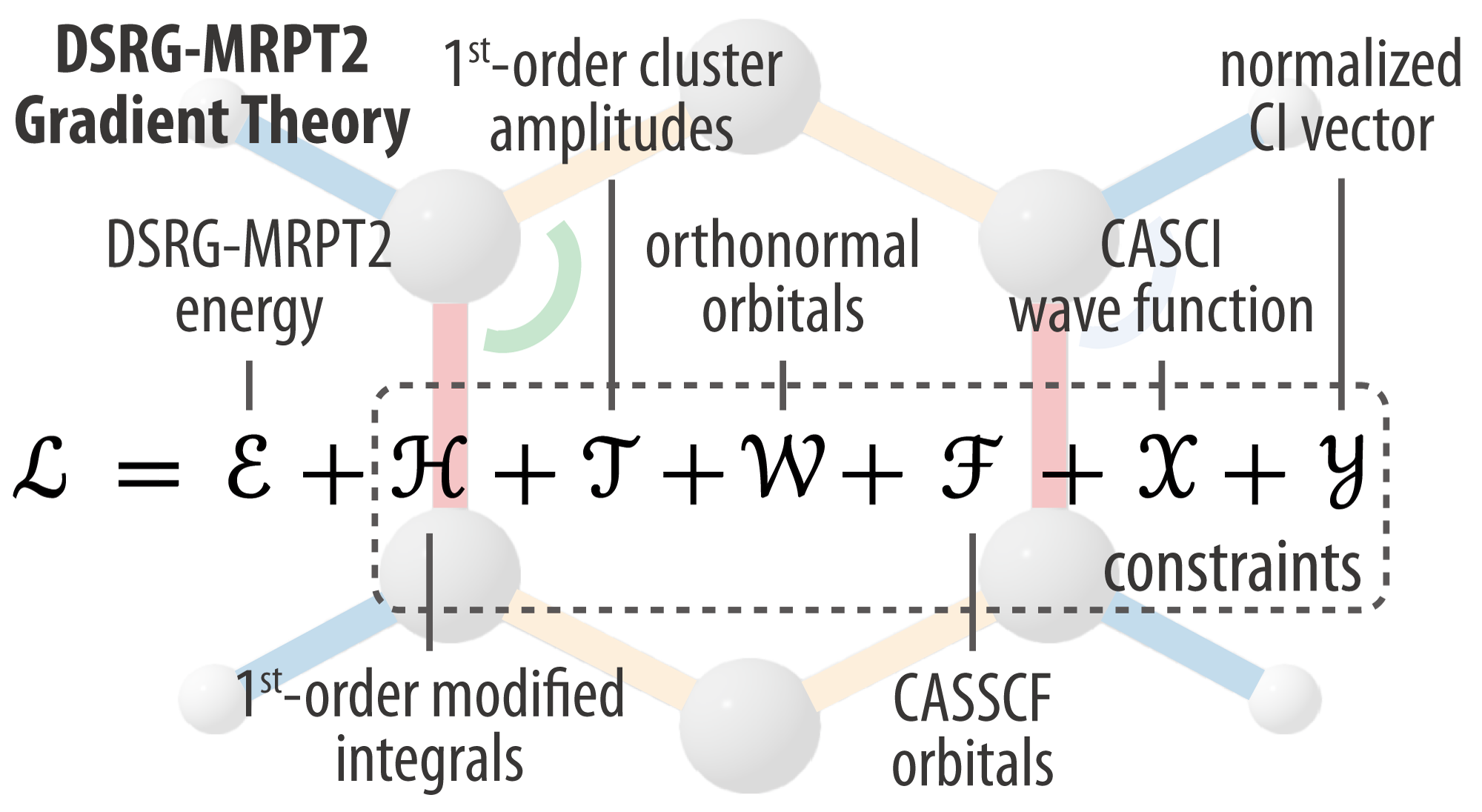
- Analytic Energy Gradients for the Driven Similarity Renormalization Group Multireference Second-Order Perturbation TheoryShuhe Wang*, Chenyang Li*, and Francesco A. Evangelista*J. Chem. Theory Comput., Dec 2021
We derive analytic energy gradients of the driven similarity renormalization group (DSRG) multireference second-order perturbation theory (MRPT2) using the method of Lagrange multipliers. In the Lagrangian, we impose constraints for a complete-active-space self-consistent-field reference wave function and the semicanonical orthonormal molecular orbitals. Solving for the associated Lagrange multipliers is found to share the same asymptotic scaling of a single DSRG-MRPT2 energy computation. A pilot implementation of the DSRG-MRPT2 analytic gradients is used to optimize the geometry of the singlet and triplet states of p-benzyne. The equilibrium bond lengths and angles are similar to those computed via other MRPT2s and Mukherjee’s multireference coupled cluster theory. An approximate DSRG-MRPT2 method that neglects the contributions of the three-body density cumulant is found to introduce negligible errors in the geometry of p-benzyne, lending itself to a promising low-cost approach for molecular geometry optimizations using large active spaces.
@article{Wang2021, archiveprefix = {arXiv}, arxivid = {2109.14548}, author = {Wang, Shuhe and Li, Chenyang and Evangelista, Francesco A.}, doi = {10.1021/acs.jctc.1c00980}, issn = {1549-9618}, journal = {J. Chem. Theory Comput.}, month = dec, number = {12}, pages = {7666--7681}, title = {{Analytic Energy Gradients for the Driven Similarity Renormalization Group Multireference Second-Order Perturbation Theory}}, url = {https://pubs.acs.org/doi/10.1021/acs.jctc.1c00980}, volume = {17}, year = {2021}, } - Spin-free formulation of the multireference driven similarity renormalization group: A benchmark study of first-row diatomic molecules and spin-crossover energeticsChenyang Li* and Francesco A. Evangelista*J. Chem. Phys., Sep 2021
We report a spin-free formulation of the multireference (MR) driven similarity renormalization group (DSRG) based on the ensemble normal ordering of Mukherjee and Kutzelnigg [J. Chem. Phys. 107, 432 (1997)]. This ensemble averages over all microstates of a given total spin quantum number, and therefore, it is invariant with respect to SU(2) transformations. As such, all equations may be reformulated in terms of spin-free quantities and they closely resemble those of spin-adapted closed-shell coupled cluster (CC) theory. The current implementation is used to assess the accuracy of various truncated MR-DSRG methods (perturbation theory up to third order and iterative methods with single and double excitations) in computing the constants of 33 first-row diatomic molecules. The accuracy trends for these first-row diatomics are consistent with our previous benchmark on a small subset of closed-shell diatomic molecules. We then present the first MR-DSRG application on transition-metal complexes by computing the spin splittings of the Fe(H2O)6]2+ and [Fe(NH3)6]2+ molecules. A focal point analysis (FPA) shows that third-order perturbative corrections are essential to achieve reasonably converged energetics. The FPA based on the linearized MR-DSRG theory with one- and two-body operators and up to a quintuple-ζ basis set predicts the spin splittings of [Fe(H2O)6]2+ and [Fe(NH3)6]2+ to be −35.7 and −17.1 kcal mol−1, respectively, showing good agreement with the results of local CC theory with singles, doubles, and perturbative triples.
@article{Li:2021sf,
  archiveprefix = {arXiv},
  arxivid = {2106.07097},
  author = {Li, Chenyang and Evangelista, Francesco A.},
  doi = {10.1063/5.0059362},
  issn = {0021-9606},
  journal = {J. Chem. Phys.},
  month = sep,
  number = {11},
  pages = {114111},
  publisher = {AIP Publishing, LLC},
  title = {{Spin-free formulation of the multireference driven similarity renormalization group: A benchmark study of first-row diatomic molecules and spin-crossover energetics}},
  url = {https://aip.scitation.org/doi/10.1063/5.0059362},
  volume = {155},
  year = {2021},
}


2020
- Tuning the Quantum Dot (QD)/Mediator Interface for Optimal Efficiency of QD-Sensitized Near-Infrared-to-Visible Photon Upconversion SystemsZihao Xu, Zhiyuan Huang, Chenyang Li*, Tingting Huang, Francesco A Evangelista, Ming Lee Tang*, and Tianquan Lian*ACS Appl. Mater. Interfaces, Aug 2020
Lead sulfide (PbS) quantum dots (QDs) have shown promising performance as a sensitizer in infrared-to-visible photon upconversion systems. To investigate the key design rules, we compare three PbS-sensitized upconversion systems using three mediator molecules with the same tetracene triplet acceptor at different distances from the QD. Using transient absorption spectroscopy, we directly measure the triplet energy-transfer rates and efficiencies from the QD to the mediator and from the mediator to the emitter. With increasing distance between the mediator and PbS QD, the efficiency of the first triplet energy transfer from the QD to the mediator decreases because of a decrease in the rate of this triplet energy-transfer step, while the efficiency of the second triplet energy transfer from the mediator to the emitter increases because of a reduction in the QD-induced mediator triplet state decay. The latter effect is a result of the slow rate constant of the second triplet energy-transfer process, which is 3 orders of magnitude slower than the diffusion-limited value. The combined results lead to a net decrease of the steady-state upconversion quantum yield with distance, which could be predicted by our kinetic model. Our result shows that the QD/mediator interface affects both the first and second triplet energy transfer processes in the photon upconversion system, and the QD/mediator distance has an opposite effect on the efficiencies of the first and second triplet energy transfer. These findings provide important insight for the further rational improvement of the overall efficiency of QD-based upconversion systems.
@article{Xu:2020bt, author = {Xu, Zihao and Huang, Zhiyuan and Li, Chenyang and Huang, Tingting and Evangelista, Francesco A and Tang, Ming Lee and Lian, Tianquan}, doi = {10.1021/acsami.0c10269}, issn = {1944-8244}, journal = {ACS Appl. Mater. Interfaces}, month = aug, number = {32}, pages = {36558--36567}, title = {{Tuning the Quantum Dot (QD)/Mediator Interface for Optimal Efficiency of QD-Sensitized Near-Infrared-to-Visible Photon Upconversion Systems}}, url = {https://pubs.acs.org/doi/10.1021/acsami.0c10269}, volume = {12}, year = {2020}, } - Connected three-body terms in single-reference unitary many-body theories: Iterative and perturbative approximationsChenyang Li* and Francesco A Evangelista*J. Chem. Phys., Jun 2020
This work introduces various approaches to include connected three-body terms in unitary many-body theories, focusing on the driven similarity renormalization group (DSRG). Starting from the least approximate method—the linearized DSRG truncated to one-, two-, and three-body operators [LDSRG(3)]—we develop several approximate LDSRG(3) models with reduced computational cost. Through a perturbative analysis, we motivate a family of iterative LDSRG(3)-n and -n′ (n = 1, 2, 3, 4) methods that contain a subset of the LDSRG(3) diagrams. Among these variants, the LDSRG(3)-2 scheme has the same computational complexity of coupled cluster theory with singles, doubles, and triples (CCSDT), but it outperforms CCSDT in the accuracy of the predicted correlation energies. We also propose and implement two perturbative triples corrections based on the linearized DSRG truncated to one- and two-body operators augmented with recursive semi-quadratic commutators [qDSRG(2)]. The resulting qDSRG(2)+(T) approach matches the accuracy of the “gold-standard” coupled cluster theory with singles, doubles, and perturbative triples model on the energetics of twenty-eight closed-shell atoms and small molecules.
@article{Li:2020fl,
  author = {Li, Chenyang and Evangelista, Francesco A},
  doi = {10.1063/5.0008353},
  issn = {0021-9606},
  journal = {J. Chem. Phys.},
  month = jun,
  number = {23},
  pages = {234116},
  title = {{Connected three-body terms in single-reference unitary many-body theories: Iterative and perturbative approximations}},
  url = {http://aip.scitation.org/doi/10.1063/5.0008353},
  volume = {152},
  year = {2020},
}


2019
- Improving the Efficiency of the Multireference Driven Similarity Renormalization Group via Sequential Transformation, Density Fitting, and the Noninteracting Virtual Orbital ApproximationTianyuan Zhang*, Chenyang Li*, and Francesco A Evangelista*J. Chem. Theory Comput., Aug 2019
This study examines several techniques to improve the efficiency of the linearized multireference driven similarity renormalization group truncated to one- and two-body operators [MR-LDSRG(2)]. We propose a sequential MR-LDSRG(2) [sq-MR-LDSRG(2)] scheme, in which one-body substitutions are folded exactly into the Hamiltonian. This new approach is combined with density fitting (DF) to reduce the storage cost of two-electron integrals. To further avoid storage of large four-index intermediates, we propose a noninteracting virtual orbital (NIVO) approximation of the Baker–Campbell–Hausdorff series that neglects commutators terms with three and four virtual indices. The NIVO approximation reduces the computational prefactor of the MR-LDSRG(2), bringing it closer to that of coupled cluster with singles and doubles (CCSD). We test the effect of the DF and NIVO approximations on the MR-LDSRG(2) and sq-MR-LDSRG(2) methods by computing properties of eight diatomic molecules. The diatomic constants obtained by DF-sq-MR-LDSRG(2)+NIVO are found to be as accurate as those from the original MR-LDSRG(2) and coupled cluster theory with singles, doubles, and perturbative triples. Finally, we demonstrate that the DF-sq-MR-LDSRG(2)+NIVO scheme can be applied to chemical systems with more than 550 basis functions by computing the automerization energy of cyclobutadiene with a quintuple-ζ basis set. The predicted automerization energy is found to be similar to the value computed with Mukherjee’s state-specific multireference coupled cluster theory with singles and doubles.
@article{Zhang:2019wj, author = {Zhang, Tianyuan and Li, Chenyang and Evangelista, Francesco A}, doi = {10.1021/acs.jctc.9b00353}, issn = {1549-9618}, journal = {J. Chem. Theory Comput.}, month = aug, number = {8}, pages = {4399--4414}, title = {{Improving the Efficiency of the Multireference Driven Similarity Renormalization Group via Sequential Transformation, Density Fitting, and the Noninteracting Virtual Orbital Approximation}}, url = {https://pubs.acs.org/doi/10.1021/acs.jctc.9b00353}, volume = {15}, year = {2019}, } - Analytic gradients for the single-reference driven similarity renormalization group second-order perturbation theoryShuhe Wang, Chenyang Li*, and Francesco A EvangelistaJ. Chem. Phys., Jul 2019
We derive and implement analytic energy gradients for the single-reference driven similarity renormalization group second-order perturbation theory (DSRG-PT2). The resulting equations possess an asymptotic scaling that is identical to that of the second-order Møller–Plesset perturbation theory (MP2), indicating that the exponential regularizer in the DSRG equations does not introduce formal difficulties in the gradient theory. We apply the DSRG-PT2 method to optimizing the geometries of 15 small molecules. The equilibrium bond lengths computed with DSRG-PT2 are found similar to those of MP2, yielding a mean absolute error of 0.0033 Å and a standard deviation of 0.0045 Å when compared with coupled cluster with singles, doubles, and perturbative triples.
@article{Wang:2019kf, author = {Wang, Shuhe and Li, Chenyang and Evangelista, Francesco A}, doi = {10.1063/1.5100175}, issn = {0021-9606}, journal = {J. Chem. Phys.}, month = jul, number = {4}, pages = {044118}, title = {{Analytic gradients for the single-reference driven similarity renormalization group second-order perturbation theory}}, url = {http://aip.scitation.org/doi/10.1063/1.5100175}, volume = {151}, year = {2019}, } - Review
 Multireference Theories of Electron Correlation Based on the Driven Similarity Renormalization GroupChenyang Li* and Francesco A Evangelista*Annu. Rev. Phys. Chem., Jun 2019
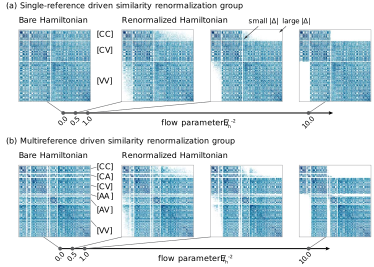
The driven similarity renormalization group (DSRG) provides an alternative way to address the intruder state problem in quantum chemistry. In this review, we discuss recent developments of multireference methods based on the DSRG. We provide a pedagogical introduction to the DSRG and its various extensions and discuss its formal properties in great detail. In addition, we report several illustrative applications of the DSRG to molecular systems.
@article{Li:2019fu, author = {Li, Chenyang and Evangelista, Francesco A}, doi = {10.1146/annurev-physchem-042018-052416}, issn = {0066-426X}, journal = {Annu. Rev. Phys. Chem.}, month = jun, number = {1}, pages = {245--273}, title = {{Multireference Theories of Electron Correlation Based on the Driven Similarity Renormalization Group}}, url = {https://www.annualreviews.org/doi/10.1146/annurev-physchem-042018-052416}, volume = {70}, year = {2019}, } - Dynamically weighted multireference perturbation theory: Combining the advantages of multi-state and state-averaged methodsChenyang Li*, Roland Lindh*, and Francesco A. Evangelista*J. Chem. Phys., Apr 2019
We introduce two new approaches to compute near-degenerate electronic states based on the driven similarity renormalization group (DSRG) framework. The first approach is a unitary multi-state formalism based on the DSRG (MS-DSRG), whereby an effective Hamiltonian is built from a set of state-specific solutions. The second approach employs a dynamic weighting parameter to smoothly interpolate between the multi-state and the state-averaged DSRG schemes. The resulting dynamically weighted DSRG (DW-DSRG) theory incorporates the most desirable features of both multi-state approaches (ability to accurately treat many states) and state-averaged methods (correct description of avoided crossings and conical intersections). We formulate second-order perturbation theories (PT2) based on the MS- and DW-DSRG and study the potential energy curves of LiF, the conical intersection of the two lowest singlet states of NH , and several low-lying excited states of benzene, naphthalene, and anthracene. The DW-DSRG-PT2 predicts the correct avoided crossing of LiF and avoids artifacts produced by the corresponding state-specific and multi-state theories. Excitation energies of the acenes computed with the DW-DSRG-PT2 are found to be more accurate than the corresponding state-averaged values, showing a small dependence on the number of states computed. 3
@article{Li:2019jk,
  author = {Li, Chenyang and Lindh, Roland and Evangelista, Francesco A.},
  doi = {10.1063/1.5088120},
  issn = {0021-9606},
  journal = {J. Chem. Phys.},
  month = apr,
  number = {14},
  pages = {144107},
  title = {{Dynamically weighted multireference perturbation theory: Combining the advantages of multi-state and state-averaged methods}},
  url = {http://aip.scitation.org/doi/10.1063/1.5088120},
  volume = {150},
  year = {2019},
}


2018
- A Combined Selected Configuration Interaction and Many-Body Treatment of Static and Dynamical Correlation in OligoacenesJeffrey B Schriber, Kevin P Hannon, Chenyang Li, and Francesco A Evangelista*J. Chem. Theory Comput., Dec 2018
We have combined our adaptive configuration interaction (ACI) [J. B. Schriber and F. A. Evangelista, J. Chem. Phys.2016, 144, 161106] with a density-fitted implementation of the second-order perturbative multireference-driven similarity renormalization group (DSRG-MRPT2) [K. P. Hannon, C. Li, and F. A. Evangelista, J. Chem. Phys.2016, 144, 204111]. We use ACI reference wave functions to recover static correlation for active spaces larger than the conventional limit of 18 orbitals. The dynamical correlation is computed using the DSRG-MRPT2 method to yield a complete treatment of electron correlation. We apply the resulting method, ACI-DSRG-MRPT2, to predict singlet–triplet gaps, metrics of open-shell character, and spin–spin correlation functions for the oligoacene series (2–7 rings). Our computations employ active spaces with as many as 30 electrons in 30 orbitals and up to 1350 basis functions, yielding gaps that are in good agreement with available experimental results. Large bases and reference relaxation lead to a significant reduction in the estimated radical character of the oligoacenes, with respect to previous valence-only treatments of correlation effects.
@article{Schriber:2018hw, author = {Schriber, Jeffrey B and Hannon, Kevin P and Li, Chenyang and Evangelista, Francesco A}, doi = {10.1021/acs.jctc.8b00877}, issn = {1549-9618}, journal = {J. Chem. Theory Comput.}, month = dec, number = {12}, pages = {6295--6305}, title = {{A Combined Selected Configuration Interaction and Many-Body Treatment of Static and Dynamical Correlation in Oligoacenes}}, url = {https://pubs.acs.org/doi/10.1021/acs.jctc.8b00877}, volume = {14}, year = {2018}, } - Conjugated Oligomers with Stable Radical Substituents: Synthesis, Single Crystal Structures, Electronic Structure, and Excited State DynamicsYiming Huang, Zihao Xu, Shijian Jin, Chenyang Li, Kurt Warncke, Francesco A Evangelista*, Tianquan Lian*, and Eilaf Egap*Chem. Mater., Nov 2018
Understanding and controlling spin dynamics in organic semiconductors is of significant technological interest. We present a comprehensive joint experimental and computational study elucidating excited-state dynamics and kinetics of oligothiophenes covalently linked to two radicals. The synthesis, steady-state, and ultrafast photophysics, magnetic properties, computational modeling, and single crystal X-ray diffraction of a series of oligothiophenes with appended nitronyl nitroxide (NN) diradicals (RAx and RBx) are presented. We show that incorporation of the diradicals results in an intriguing molecular packing that is reminiscent of organic cages, unusual excited-state dynamics, and interesting photophysical and magnetic properties. We find an increase in the distance and dihedral angle between the diradical rings and the oligothiophene core result in weak antiferromagnetic interactions. Single crystal X-ray diffraction and computational modeling suggest that efficient conjugation along the backbone leads to an efficient spin-polarization transfer. Insertion of p-phenylene linkers that separate the oligothiophene core from the NN radical component by an average of only 4.3 Å results in a decrease in orbital overlap between the chromophore and singly occupied molecular orbital of the two NN radicals and a weak spin polarization along the thiophene core. Computations also predict a biradical ground state with a small singlet–triplet energy gap (ΔEST) of 0.6 kcal/mol or less, where the triplet lies above the singlet, suggesting that in some of these molecules both the singlet and triplet states are thermally populated. Together, the steady-state optical absorption, computational study, and ultrafast transient absorption suggest enhanced internal conversion is the dominant pathway for rapid decay in RAx and RBx diradical series due to two major factors: (i) incorporation of the radicals results in new low-lying singlet and triplet states (S1/T1) that act as “trap states”; and (ii) generation of multiple singlet and triplet states that are essentially degenerate in energy. Since incorporation of NN diradicals leads to more than 20 low-lying near degenerate singlet, triplet and quintet states, both intersystem crossing and internal conversion become viable decay mechanisms for the decay of the Sn and Tn states back to the S0 and T0. These results establish and correlate structural and electronic parameters that impact spin coupling, spin delocalization, and determine general trends in predicting energy levels of excited states.
@article{Huang:2018kz, author = {Huang, Yiming and Xu, Zihao and Jin, Shijian and Li, Chenyang and Warncke, Kurt and Evangelista, Francesco A and Lian, Tianquan and Egap, Eilaf}, doi = {10.1021/acs.chemmater.8b03366}, issn = {0897-4756}, journal = {Chem. Mater.}, month = nov, number = {21}, pages = {7840--7851}, title = {{Conjugated Oligomers with Stable Radical Substituents: Synthesis, Single Crystal Structures, Electronic Structure, and Excited State Dynamics}}, url = {https://pubs.acs.org/doi/10.1021/acs.chemmater.8b03366}, volume = {30}, year = {2018}, } - Driven similarity renormalization group for excited states: A state-averaged perturbation theoryChenyang Li* and Francesco A Evangelista*J. Chem. Phys., Mar 2018
The multireference driven similarity renormalization group (MRDSRG) approach [C. Li and F. A. Evangelista, J. Chem. Theory Comput. 11, 2097 (2015)] is generalized to treat quasi-degenerate electronic excited states. The new scheme, termed state-averaged (SA) MRDSRG, is a state-universal approach that considers an ensemble of quasi-degenerate states on an equal footing. Using the SA-MRDSRG framework, we implement second- (SA-DSRG-PT2) and third-order (SA-DSRG-PT3) perturbation theories. These perturbation theories can treat a manifold of near-degenerate states at the cost of a single state-specific computation. At the same time, they have several desirable properties: (1) they are intruder-free and size-extensive, (2) their energy expressions can be evaluated non-iteratively and require at most the three-body density cumulant of the reference states, and (3) the reference states are allowed to relax in the presence of dynamical correlation effects. Numerical benchmarks on the potential energy surfaces of lithium fluoride, ammonia, and the penta-2,4-dieniminium cation reveal that the SA-DSRG-PT2 method yields results with accuracy similar to that of other second-order quasi-degenerate perturbation theories. The SA-DSRG-PT3 results are instead consistent with those from multireference configuration interaction with singles and doubles (MRCISD). Finally, we compute the vertical excitation energies of (E,E)-1,3,5,7-octatetraene. The ordering of the lowest three states is predicted to be 2 1Ag– < 1 1Bu+ < 1 1Bu– by both SA-DSRG-PT2 and SA-DSRG-PT3, in accordance with MRCISD plus Davidson correction.
@article{Li:2018kl, author = {Li, Chenyang and Evangelista, Francesco A}, doi = {10.1063/1.5019793}, issn = {0021-9606}, journal = {J. Chem. Phys.}, month = mar, number = {12}, pages = {124106}, title = {{Driven similarity renormalization group for excited states: A state-averaged perturbation theory}}, url = {http://aip.scitation.org/doi/10.1063/1.5019793}, volume = {148}, year = {2018}, } - ErratumErratum: “Towards numerically robust multireference theories: The driven similarity renormalization group truncated to one- and two-body operators” [J. Chem. Phys. 144, 164114 (2016)]Chenyang Li and Francesco A Evangelista*J. Chem. Phys., Feb 2018
@article{Li:2018dy, author = {Li, Chenyang and Evangelista, Francesco A}, doi = {10.1063/1.5023493}, issn = {0021-9606}, journal = {J. Chem. Phys.}, month = feb, number = {7}, pages = {079903}, title = {{Erratum: “Towards numerically robust multireference theories: The driven similarity renormalization group truncated to one- and two-body operators” [J. Chem. Phys. 144, 164114 (2016)]}}, url = {http://aip.scitation.org/doi/10.1063/1.5023493}, volume = {148}, year = {2018}, } - ErratumErratum: “Driven similarity renormalization group: Third-order multireference perturbation theory” [J. Chem. Phys. 146, 124132 (2017)]Chenyang Li* and Francesco A Evangelista*J. Chem. Phys., Feb 2018
@article{Li:2018fn,
  author = {Li, Chenyang and Evangelista, Francesco A},
  doi = {10.1063/1.5023904},
  issn = {0021-9606},
  journal = {J. Chem. Phys.},
  month = feb,
  number = {7},
  pages = {079902},
  title = {{Erratum: “Driven similarity renormalization group: Third-order multireference perturbation theory” [J. Chem. Phys. 146, 124132 (2017)]}},
  url = {http://aip.scitation.org/doi/10.1063/1.5023904},
  volume = {148},
  year = {2018},
}


2017
- A low-cost approach to electronic excitation energies based on the driven similarity renormalization groupChenyang Li, Prakash Verma, Kevin P Hannon, and Francesco A Evangelista*J. Chem. Phys., Aug 2017
We propose an economical state-specific approach to evaluate electronic excitation energies based on the driven similarity renormalization group truncated to second order (DSRG-PT2). Starting from a closed-shell Hartree–Fock wave function, a model space is constructed that includes all single or single and double excitations within a given set of active orbitals. The resulting VCIS-DSRG-PT2 and VCISD-DSRG-PT2 methods are introduced and benchmarked on a set of 28 organic molecules [M. Schreiber et al., J. Chem. Phys. 128, 134110 (2008)]. Taking CC3 results as reference values, mean absolute deviations of 0.32 and 0.22 eV are observed for VCIS-DSRG-PT2 and VCISD-DSRG-PT2 excitation energies, respectively. Overall, VCIS-DSRG-PT2 yields results with accuracy comparable to those from time-dependent density functional theory using the B3LYP functional, while VCISD-DSRG-PT2 gives excitation energies comparable to those from equation-of-motion coupled cluster with singles and doubles.
@article{Li:2017ff, author = {Li, Chenyang and Verma, Prakash and Hannon, Kevin P and Evangelista, Francesco A}, doi = {10.1063/1.4997480}, issn = {0021-9606}, journal = {J. Chem. Phys.}, month = aug, number = {7}, pages = {074107}, title = {{A low-cost approach to electronic excitation energies based on the driven similarity renormalization group}}, url = {http://aip.scitation.org/doi/10.1063/1.4997480}, volume = {147}, year = {2017}, } - Driven similarity renormalization group: Third-order multireference perturbation theoryChenyang Li* and Francesco A Evangelista*J. Chem. Phys., Mar 2017
A third-order multireference perturbation theory based on the driven similarity renormalization group (DSRG-MRPT3) approach is presented. The DSRG-MRPT3 method has several appealing features: (a) it is intruder free, (b) it is size consistent, (c) it leads to a non-iterative algorithm with O(N6) scaling, and (d) it includes reference relaxation effects. The DSRG-MRPT3 scheme is benchmarked on the potential energy curves of F2, H2O2, C2H6, and N2 along the F–F, O–O, C–C, and N–N bond dissociation coordinates, respectively. The nonparallelism errors of DSRG-MRPT3 are consistent with those of complete active space third-order perturbation theory and multireference configuration interaction with singles and doubles and show significant improvements over those obtained from DSRG second-order multireference perturbation theory. Our efficient implementation of the DSRG-MRPT3 based on factorized electron repulsion integrals enables studies of medium-sized open-shell organic compounds. This point is demonstrated with computations of the singlet-triplet splitting (ΔST = ET – ES) of 9,10-anthracyne. At the DSRG-MRPT3 level of theory, our best estimate of the adiabatic ΔST is 3.9 kcal mol−1, a value that is within 0.1 kcal mol−1 from multireference coupled cluster results.
@article{Li:2017bx,
  author = {Li, Chenyang and Evangelista, Francesco A},
  doi = {10.1063/1.4979016},
  issn = {0021-9606},
  journal = {J. Chem. Phys.},
  month = mar,
  number = {12},
  pages = {124132},
  title = {{Driven similarity renormalization group: Third-order multireference perturbation theory}},
  url = {http://aip.scitation.org/doi/10.1063/1.4979016},
  volume = {146},
  year = {2017},
}

2016
- An integral-factorized implementation of the driven similarity renormalization group second-order multireference perturbation theoryKevin P Hannon, Chenyang Li, and Francesco A Evangelista*J. Chem. Phys., May 2016
We report an efficient implementation of a second-order multireference perturbation theory based on the driven similarity renormalization group (DSRG-MRPT2) [C. Li and F. A. Evangelista, J. Chem. Theory Comput. 11, 2097 (2015)]. Our implementation employs factorized two-electron integrals to avoid storage of large four-index intermediates. It also exploits the block structure of the reference density matrices to reduce the computational cost to that of second-order Møller–Plesset perturbation theory. Our new DSRG-MRPT2 implementation is benchmarked on ten naphthyne isomers using basis sets up to quintuple-ζ quality. We find that the singlet-triplet splittings (ΔST) of the naphthyne isomers strongly depend on the equilibrium structures. For a consistent set of geometries, the ΔST values predicted by the DSRG-MRPT2 are in good agreements with those computed by the reduced multireference coupled cluster theory with singles, doubles, and perturbative triples.
@article{Hannon:2016bh, author = {Hannon, Kevin P and Li, Chenyang and Evangelista, Francesco A}, doi = {10.1063/1.4951684}, issn = {0021-9606}, journal = {J. Chem. Phys.}, month = may, number = {20}, pages = {204111}, title = {{An integral-factorized implementation of the driven similarity renormalization group second-order multireference perturbation theory}}, url = {http://aip.scitation.org/doi/10.1063/1.4951684}, volume = {144}, year = {2016}, } - Towards numerically robust multireference theories: The driven similarity renormalization group truncated to one- and two-body operatorsChenyang Li and Francesco A Evangelista*J. Chem. Phys., Apr 2016
The first nonperturbative version of the multireference driven similarity renormalization group (MR-DSRG) theory [C. Li and F. A. Evangelista, J. Chem. Theory Comput. 11, 2097 (2015)] is introduced. The renormalization group structure of the MR-DSRG equations ensures numerical robustness and avoidance of the intruder-state problem, while the connected nature of the amplitude and energy equations guarantees size consistency and extensivity. We approximate the MR-DSRG equations by keeping only one- and two-body operators and using a linearized recursive commutator approximation of the Baker–Campbell–Hausdorff expansion [T. Yanai and G. K.-L. Chan, J. Chem. Phys. 124, 194106 (2006)]. The resulting linearized MR-DSRG scheme with one- and two-body operators [MR-LDSRG(2)] contains only 39 terms and scales as O(N2NP2NH2) where NH, NP, and N correspond to the number of hole, particle, and total orbitals, respectively. Benchmark MR-LDSRG(2) computations on the hydrogen fluoride and molecular nitrogen binding curves and the singlet-triplet splitting of p-benzyne yield results comparable in accuracy to those from multireference configuration interaction, Mukherjee multireference coupled cluster theory, and internally contracted multireference coupled cluster theory.
@article{Li:2016hb,
  author = {Li, Chenyang and Evangelista, Francesco A},
  doi = {10.1063/1.4947218},
  issn = {0021-9606},
  journal = {J. Chem. Phys.},
  month = apr,
  number = {16},
  pages = {164114},
  title = {{Towards numerically robust multireference theories: The driven similarity renormalization group truncated to one- and two-body operators}},
  url = {http://aip.scitation.org/doi/10.1063/1.4947218},
  volume = {144},
  year = {2016},
}

2015
- Multireference Driven Similarity Renormalization Group: A Second-Order Perturbative AnalysisChenyang Li and Francesco A Evangelista*J. Chem. Theory Comput., May 2015
We introduce a multireference version of the driven similarity renormalization group (DSRG) approach [Evangelista, F. A. J. Chem. Phys. 2014, 141, 054109] based on a generalized reference wave function and operator normal ordering [Kutzelnigg, W.; Mukherjee, D. J. Chem. Phys. 1997, 107, 432]. We perform a perturbative analysis of the corresponding equations at second order and derive a novel multireference perturbation theory, termed DSRG-MRPT2. The DSRG-MRPT2 energy equation can be written in a simple and compact form and can be solved via a noniterative procedure that requires at most the three-body density cumulant of the reference. Importantly, even at the perturbation level, the multireference DSRG is free from the intruder-state problem. We propose an optimal range of the DSRG flow parameter that consistently yields reliable potential energy curves with minimal nonparallelism error. We find that the DSRG-MRPT2 can describe the potential energy curves of HF and N2, and the singlet–triplet gap of p-benzyne with an accuracy similar to that of other multireference perturbation theories.
@article{Li:2015iz, author = {Li, Chenyang and Evangelista, Francesco A}, doi = {10.1021/acs.jctc.5b00134}, issn = {1549-9618}, journal = {J. Chem. Theory Comput.}, month = may, number = {5}, pages = {2097--2108}, title = {{Multireference Driven Similarity Renormalization Group: A Second-Order Perturbative Analysis}}, url = {https://pubs.acs.org/doi/10.1021/acs.jctc.5b00134}, volume = {11}, year = {2015}, } - Intricate Internal Rotation Surface and Fundamental Infrared Transitions of the n-Propyl RadicalChenyang Li, Jay Agarwal, Chia-Hua Wu, Wesley D Allen, and Henry F Schaefer*J. Phys. Chem. B, Jan 2015
The potential energy surface for methylene hindered internal rotation is examined for the n-propyl radical, a molecule fundamental to combustion chemistry. Six stationary points are identified, and four of them are unique: 1, 2, TS1, and TS2. The remaining two structures 1’ and TS1’ are mirror images with respect to 1 and TS1. Focal point analysis, converged to the complete basis set limit of coupled-cluster theory with single, double, triple, and perturbative quadruple excitations [CCSDT(Q)], is employed to obtain the relative energies of these structures. A one-dimensional potential energy surface (PES) is constructed by explicitly mapping out a distinguished reaction path via constrained geometry optimizations. A "double-well" feature is observed on the electronic PES, but under the adiabatic approximation, the enthalpic (0 K) PES becomes a regular single-well potential with the expected 180° periodicity. The corresponding one-dimensional vibrational Schrödinger equation is solved using the Cooley–Numerov approach to obtain vibrational states of the methylene torsional motion. The predicted barrier for internal rotation is 105.5 and 137.2 cm–1 for the electronic and enthalpic surfaces, respectively. Anharmonic (fundamental) vibrational frequencies are predicted for structure 1 using second-order vibrational perturbation theory, and the band origins for 11 modes are reported. Comparison with previous electron spin resonance and infrared spectroscopic work, in addition to other theoretical investigations, is made where possible.
@article{Li:2015jw,
  author = {Li, Chenyang and Agarwal, Jay and Wu, Chia-Hua and Allen, Wesley D and Schaefer, Henry F},
  doi = {10.1021/jp504764t},
  issn = {1520-6106},
  journal = {J. Phys. Chem. B},
  month = jan,
  number = {3},
  pages = {728--735},
  title = {{Intricate Internal Rotation Surface and Fundamental Infrared Transitions of the n-Propyl Radical}},
  url = {https://pubs.acs.org/doi/10.1021/jp504764t},
  volume = {119},
  year = {2015},
}


2014
- The Remarkable [ReH9]2– Dianion: Molecular Structure and Vibrational FrequenciesChenyang Li, Jay Agarwal, and Henry F Schaefer*J. Phys. Chem. B, Jun 2014
The equilibrium geometries and vibrational frequencies of the extraordinary [ReH9]2– dianion (D3h symmetry) are investigated using Hartree–Fock (HF) theory, coupled cluster theory with single and double excitations (CCSD), and coupled cluster theory with single, double, and perturbative triple excitations [CCSD(T)]. The new generation of energy-consistent relativistic pseudopotentials and correlation consistent basis sets [cc-pVXZ-PP (Re) and cc-pVXZ (H) (X = D, T, Q)] are used. Anharmonicity was considered using second-order vibrational perturbation theory. The predicted geometries and vibrational frequencies generally agree with experimental findings. In order to stabilize the [ReH9]2– dianion, the M2ReH9 (M = Na, K) sandwich complexes (D3h symmetry) are studied at the CCSD(T)/VTZ (VTZ = cc-pVTZ-PP (Re) and cc-pVTZ (H, Na, K)) level of theory. Compared to the [ReH9]2– dianion, the predicted vibrational frequencies involving Re–H stretching modes are improved, indicating the importance of considering counterions in electronically dense systems. The natural bond orbital analysis shows that each H atom only bonds with the Re center, and the 5d orbitals of Re and 1s orbitals of H are major factors for the covalent Re–H bonding.
@article{Li:2014bm,
  author = {Li, Chenyang and Agarwal, Jay and Schaefer, Henry F},
  doi = {10.1021/jp412003s},
  issn = {1520-6106},
  journal = {J. Phys. Chem. B},
  month = jun,
  number = {24},
  pages = {6482--6490},
  title = {{The Remarkable [ReH<sub>9</sub>]<sup>2–</sup> Dianion: Molecular Structure and Vibrational Frequencies}},
  url = {https://pubs.acs.org/doi/10.1021/jp412003s},
  volume = {118},
  year = {2014},
}
