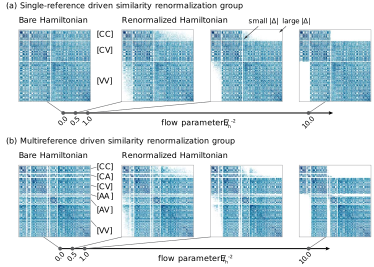
The driven similarity renormalization group (DSRG) is a modern many-body framework for systematically incorporating dynamical electron correlation in molecular systems [1]. In DSRG, a continuous unitary transformation is used to decouple reference and excited configurations, with a flow parameter that controls the extent of correlation included. This parameter effectively suppresses small energy denominators, leading to numerically stable and well-behaved equations.
The DSRG approach provides a flexible foundation for developing multireference methods, offering balanced treatments of dynamical and static correlation. Its robust formulation makes it particularly attractive for strongly correlated systems, such as excited states [2] and transition-metal chemistry [3]. When combined with the density matrix renormalization group, DSRG offers a scalable route to accurate multireference calculations for large active spaces containing more than 40 active orbitals [3].
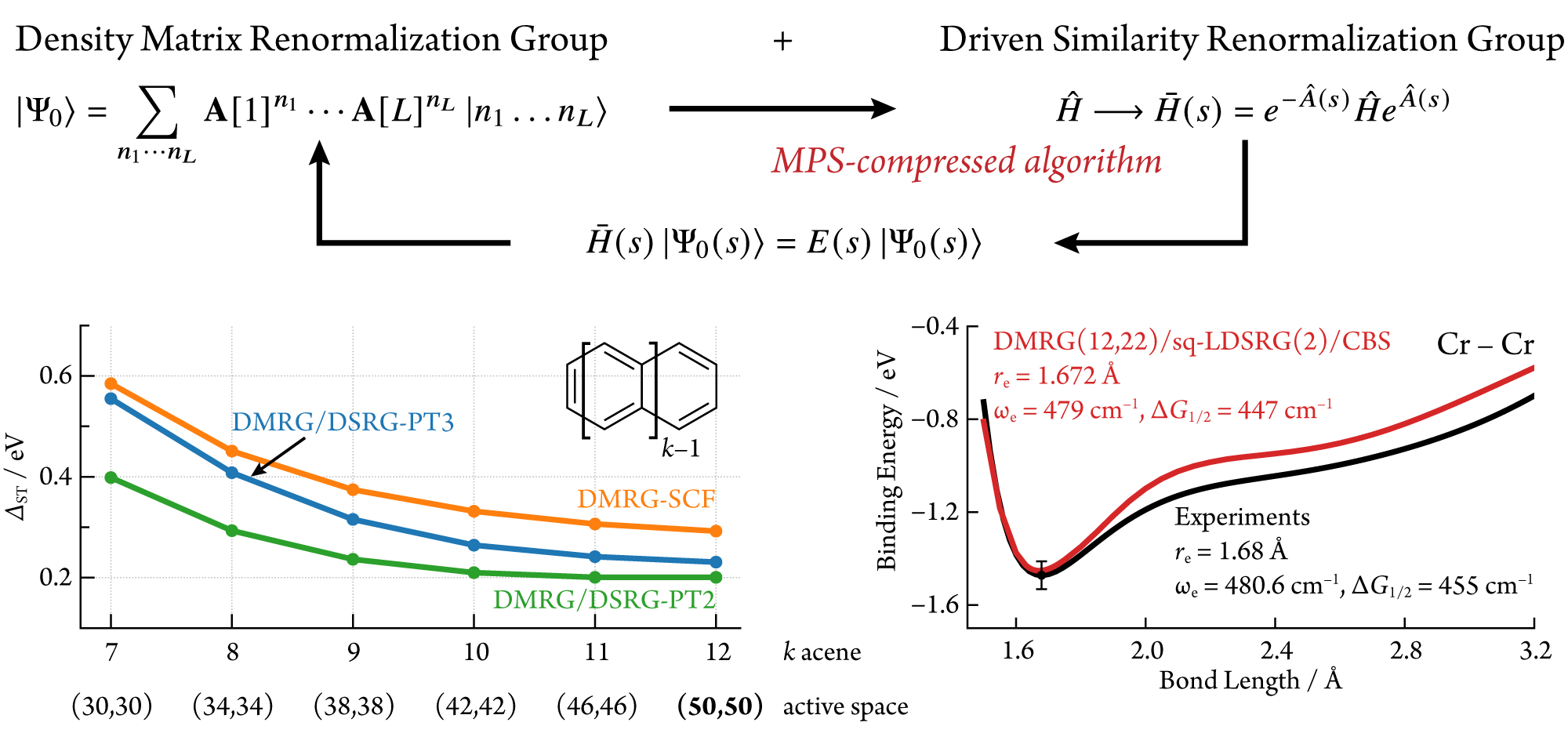
We present a new implementation of the driven similarity renormalization group (DSRG) based on a density matrix renormalization group (DMRG) reference. The explicit build of high-order reduced density matrices is avoided by forming matrix-product-state compressed intermediates. This algorithm facilitates the application of DSRG second- and third-order perturbation theories to dodecacene with an active space of 50 electrons in 50 orbitals. This active space appears the largest employed to date within the framework of internally contracted multireference formalism. The DMRG-DSRG approach is applied to several challenging systems, including the singlet-triplet gaps (ΔST) of oligoacenes ranging from naphthalene to dodecacene, the vertical excitation energies of zeaxanthin, and the ground-state potential energy curve (PEC) of Cr2 molecule. Our best estimate for the vertical ΔST of dodecacene is 0.22 eV, showing an excellent agreement with that of the linearized adiabatic connection method (0.24 eV). For zeaxanthin, all DSRG schemes suggest the order of 2 1Ag– < 1 1Bu+ < 1 1Bu– for excited states. Both the equilibrium and the shoulder regions of the Cr2 PEC are reasonably reproduced by the linearized DSRG with one- and two-body operators.
@article{Li2025,archiveprefix={arXiv},arxivid={2503.01299},author={Li, Chenyang and Wang, Xiaoxue and Zhai, Huanchen and Fang, Wei-Hai},doi={10.1021/acs.jctc.5c00322},issn={1549-9618},journal={J. Chem. Theory Comput.},month=jun,number={11},pages={5445--5456},title={{Driven Similarity Renormalization Group with a Large Active Space: Applications to Oligoacenes, Zeaxanthin, and Chromium Dimer}},url={http://arxiv.org/abs/2503.01299 https://pubs.acs.org/doi/10.1021/acs.jctc.5c00322},volume={21},year={2025},}
Assessment of State-Averaged Driven Similarity Renormalization Group on Vertical Excitation Energies: Optimal Flow Parameters and Applications to Nucleobases
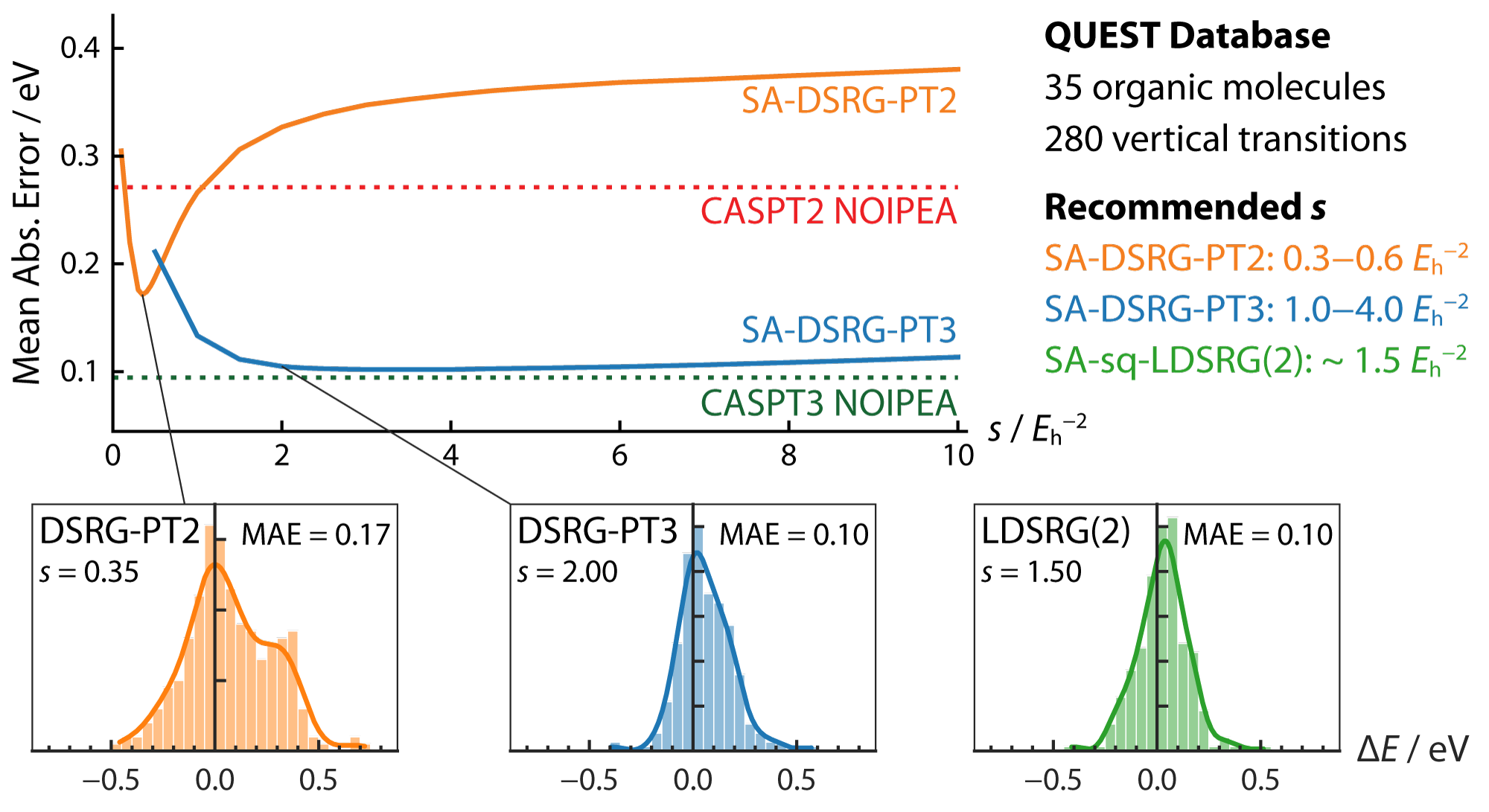
We present a comprehensive excited-state benchmark for the state-averaged (SA) driven similarity renormalization group (DSRG) [Li, C.; Evangelista, F. A. J. Chem. Phys. 2018, 148, 124106]. Following the QUEST database [Véril, M.; Scemama, A.; Caffarel, M.; Lipparini, F.; Boggio-Pasqua, M.; Jacquemin, D.; Loos, P.-F. Wiley Interdiscip. Rev. Comput. Mol. Sci. 2021, 11, e1517], 280 vertical transition energies of 35 medium-sized molecules are computed using the SA-DSRG derived second- and third-order perturbation theories (PT2/PT3) along with a nonperturbative approach [sq-LDSRG(2)]. Comparing to the theoretical best estimates, the optimal flow parameter is found to be 0.35 and 2.0 Eh–2 for SA-DSRG-PT2 and SA-DSRG-PT3, respectively. For SA-sq-LDSRG(2), a flow parameter of 1.5 Eh–2 provides converged equations without compromising the accuracy. We then assess the accuracy of the SA-DSRG hierarchy using these parameters. The SA-DSRG-PT2 scheme outperforms the level-shifted CASPT2 by 0.10 eV in mean absolute error (MAE), yet this accuracy is slightly inferior than that of CASPT2 with the ionization-potential–electron-affinity shift. Both SA-DSRG-PT3 and SA-sq-LDSRG(2) yield a MAE of 0.10 eV, which is comparable to that of CASPT3 (0.09 eV). Finally, we compute vertical excitation energies of several low-lying singlet states of nucleobases. The SA-sq-LDSRG(2) approach provides highly accurate results for π → π* excitations, while n → π* transitions are better described by SA-DSRG-PT3.
@article{Wang2023,author={Wang, Meng and Fang, Wei-Hai and Li, Chenyang},doi={10.1021/acs.jctc.2c00966},issn={1549-9618},journal={J. Chem. Theory Comput.},month=jan,number={1},pages={122--136},title={{Assessment of State-Averaged Driven Similarity Renormalization Group on Vertical Excitation Energies: Optimal Flow Parameters and Applications to Nucleobases}},url={https://pubs.acs.org/doi/10.1021/acs.jctc.2c00966},volume={19},year={2023},}
2019
Review
Multireference Theories of Electron Correlation Based on the Driven Similarity Renormalization Group
The driven similarity renormalization group (DSRG) provides an alternative way to address the intruder state problem in quantum chemistry. In this review, we discuss recent developments of multireference methods based on the DSRG. We provide a pedagogical introduction to the DSRG and its various extensions and discuss its formal properties in great detail. In addition, we report several illustrative applications of the DSRG to molecular systems.
@article{Li:2019fu,author={Li, Chenyang and Evangelista, Francesco A},doi={10.1146/annurev-physchem-042018-052416},issn={0066-426X},journal={Annu. Rev. Phys. Chem.},month=jun,number={1},pages={245--273},title={{Multireference Theories of Electron Correlation Based on the Driven Similarity Renormalization Group}},url={https://www.annualreviews.org/doi/10.1146/annurev-physchem-042018-052416},volume={70},year={2019},}