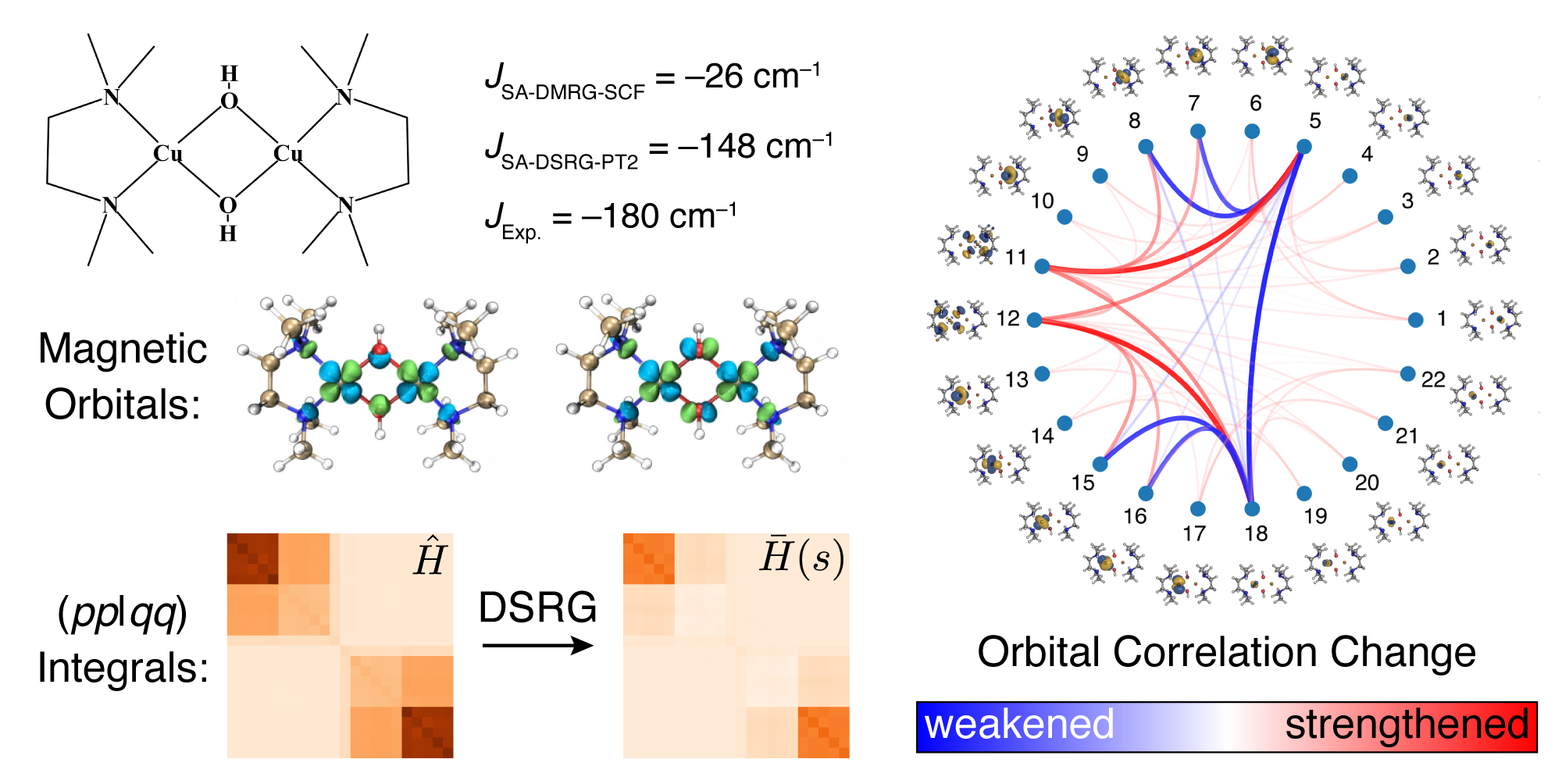
Magnetism in transition-metal complexes arises from the interplay of strong electron correlation and relativistic effects. Accurate prediction of magnetic exchange couplings in polynuclear systems is essential for understanding spin states, magnetic communication pathways, and the design of molecular magnetic materials.
Recently, we have investigated magnetic exchange interactions in 3d bimetallic complexes [1]. We demonstrated that our approach yields reliable exchange coupling constants together with clear mechanistic insight into the underlying superexchange pathways. Looking ahead, we aim to extend our methodology to the computation of magnetic response properties, including the electronic g tensor, which plays a central role in electron paramagnetic resonance spectroscopy and the characterization of anisotropic magnetic behavior.
Towards quantitative computations of exchange coupling constants in transition-metal complexes via multireference driven similarity renormalization group
The accurate prediction of magnetic exchange coupling constants (J) in transition-metal complexes remains challenging for electronic structure theory. In this work, we demonstrate that the state-averaged driven similarity renormalization group second-order perturbation theory (SA-DSRG-PT2), combined with the density matrix renormalization group, provides quantitative J values on a set of 21 3d bimetallic complexes with a focus on dicopper species. Active orbitals are systematically identified using the atomic valence active space approach, ensuring a consistent inclusion of metal 3d and 4d shells, and the ligand orbitals involved in superexchange pathways. Analysis of the SA-DSRG-PT2 effective Hamiltonians indicates that the reduction of on-site Coulomb repulsion is the primary origin of the improved exchange couplings. In addition, we adopt the orbital mutual correlation plot as an intuitive tool to visualize exchange pathways, allowing direct identifications of metal-metal and metal-ligand correlations and their modulation by dynamical correlation. These results establish SA-DSRG- PT2 as a robust and practical multireference approach for studying magnetic interactions in transition-metal complexes.
@article{Hu2026,author={Hu, Ziyu and Li, Chenyang},doi={10.1021/acs.inorgchem.5c05829},issn={0020-1669},journal={Inorg. Chem.},month=mar,number={13},pages={7186--7196},title={{Towards quantitative computations of exchange coupling constants in transition-metal complexes via multireference driven similarity renormalization group}},url={https://pubs.acs.org/doi/10.1021/acs.inorgchem.5c05829},volume={65},year={2026},}