Accurate wave function methods are often limited by their steep computational cost, which grows rapidly with system size. A central goal of our research is to develop reduced-scaling approaches that retain the accuracy of high-level electronic-structure methods while significantly lowering their computational demands.
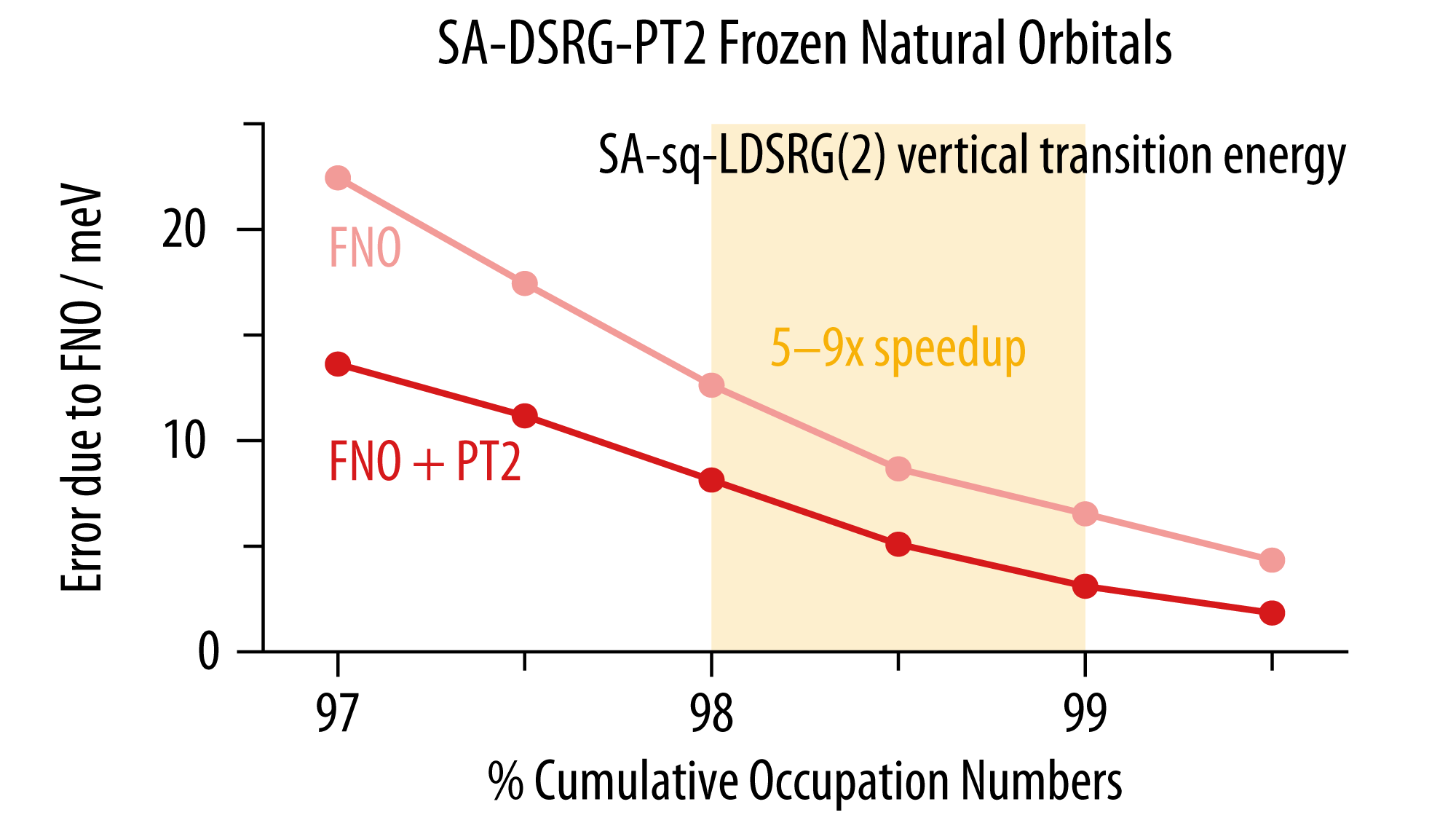
In the multireference (MR) context, we have developed frozen natural orbital techniques for the driven similarity renormalization group (DSRG) [1]. By truncating the virtual orbital space based on natural occupation numbers, this approach greatly reduces the cost of dynamical correlation treatments while preserving high accuracy. More broadly, we are interested in exploring reduced-scaling strategies to extend the reach of accurate electronic structure theory to complex chemical environments. Examples include local correlation methods based on pair natural orbitals and tensor decomposition techniques [2].
We present a reduced-cost implementation of the state-averaged driven similarity renormalization group (SA-DSRG) based on the frozen natural orbital (FNO) approach. The natural orbitals (NOs) are obtained by diagonalizing the one-body reduced density matrix from SA-DSRG second-order perturbation theory (SA-DSRG-PT2). We consider three criteria to truncate the virtual NOs for the subsequent electron correlation treatment beyond SA-DSRG-PT2. An additive second-order correction is applied to the SA-DSRG Hamiltonian to reintroduce correlation effects from the discarded orbitals. The FNO SA-DSRG method is benchmarked on 35 small organic molecules in the QUEST database. When keeping 98–99% of the cumulative occupation numbers, the mean absolute error in the vertical transition energies due to FNO is less than 0.01 eV. Using the same FNO threshold, we observe a speedup of 9 times compared to the conventional SA-DSRG implementation for nickel carbonyl with a quadruple-ζ basis set. The FNO approach enables nonperturbative SA-DSRG computations on chloroiron corrole [FeCl(C19H11N4)] with more than 1000 basis functions, surpassing the current limit of a conventional implementation.
@article{Li2024c,author={Li, Chenyang and Mao, Shuxian and Huang, Renke and Evangelista, Francesco A.},doi={10.1021/acs.jctc.4c00152},issn={1549-9618},journal={J. Chem. Theory Comput.},month=may,number={10},pages={4170--4181},title={{Frozen Natural Orbitals for the State-Averaged Driven Similarity Renormalization Group}},url={https://pubs.acs.org/doi/10.1021/acs.jctc.4c00152},volume={20},year={2024},}
We report an efficient implementation of a second-order multireference perturbation theory based on the driven similarity renormalization group (DSRG-MRPT2) [C. Li and F. A. Evangelista, J. Chem. Theory Comput. 11, 2097 (2015)]. Our implementation employs factorized two-electron integrals to avoid storage of large four-index intermediates. It also exploits the block structure of the reference density matrices to reduce the computational cost to that of second-order Møller–Plesset perturbation theory. Our new DSRG-MRPT2 implementation is benchmarked on ten naphthyne isomers using basis sets up to quintuple-ζ quality. We find that the singlet-triplet splittings (ΔST) of the naphthyne isomers strongly depend on the equilibrium structures. For a consistent set of geometries, the ΔST values predicted by the DSRG-MRPT2 are in good agreements with those computed by the reduced multireference coupled cluster theory with singles, doubles, and perturbative triples.
@article{Hannon:2016bh,author={Hannon, Kevin P and Li, Chenyang and Evangelista, Francesco A},doi={10.1063/1.4951684},issn={0021-9606},journal={J. Chem. Phys.},month=may,number={20},pages={204111},title={{An integral-factorized implementation of the driven similarity renormalization group second-order multireference perturbation theory}},url={http://aip.scitation.org/doi/10.1063/1.4951684},volume={144},year={2016},}