Relativistic effects become essential for molecules containing heavy elements, where high nuclear charges lead to significant scalar relativistic corrections and spin–orbit coupling (SOC). These effects strongly influence electronic structure, spectroscopic properties, and chemical reactivity, particularly in transition-metal and lanthanide/actinide complexes.
In our group, we are interested in developing robust and computationally affordable multireference methods for treating relativistic phenomena in complex molecular systems. We have recently developed an efficient treatment of SOC within the state-averaged driven similarity renormalization group second-order perturbation theory [1], [2]. This approach enables cost-effective and reliable SOC calculations for systems containing heavy elements.
Simultaneous Treatment of Electron Correlation and Spin-Orbit Coupling with State-Averaged Driven Similarity Renormalization Group Second-Order Perturbation Theory
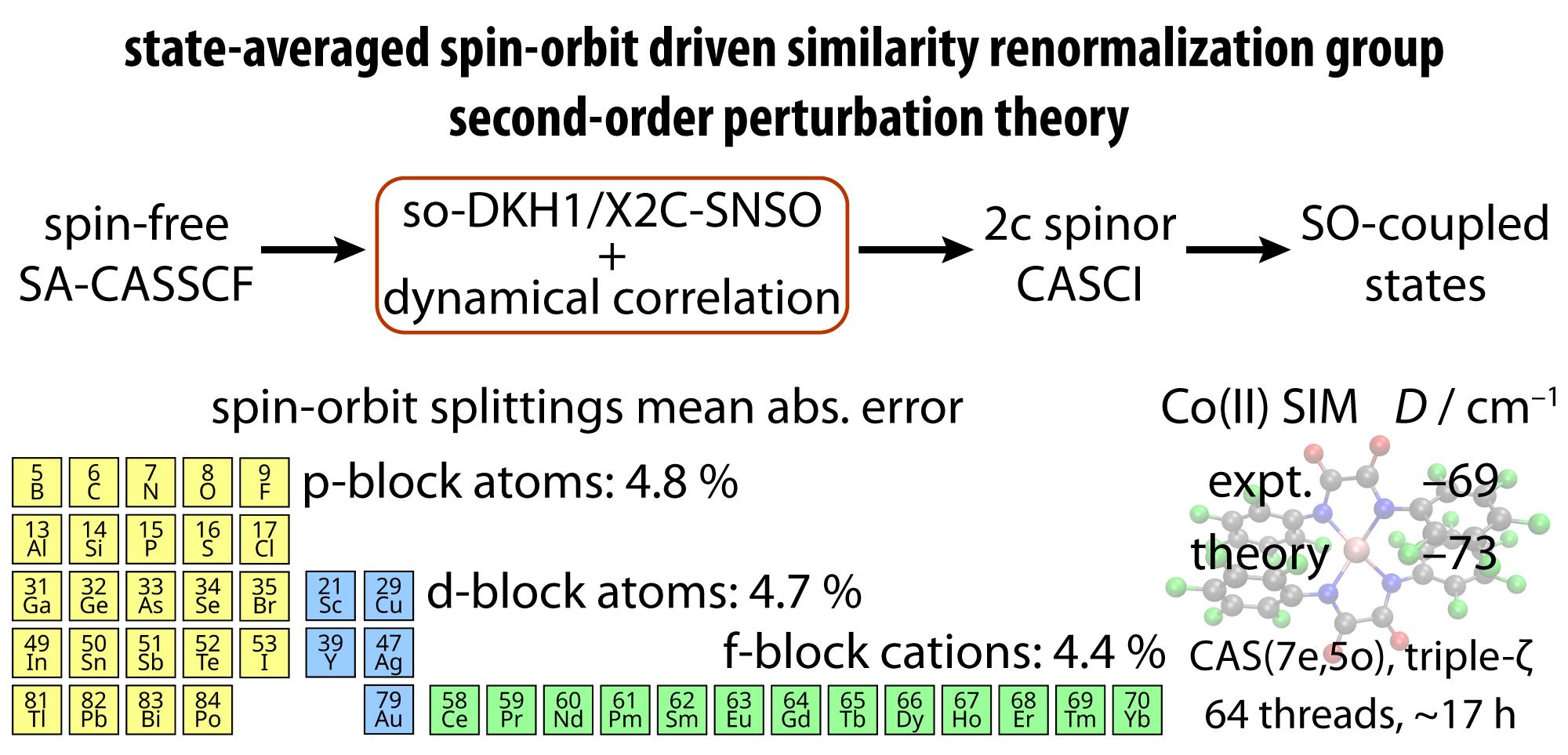
We report the state-averaged spin–orbit driven similarity renormalization group second-order perturbation theory (SA-SO-DSRG-PT2) for efficient computations of spin–orbit coupling (SOC) effects in multireference systems. This approach adopts a set of multiconfigurational reference states obtained with a spin-free relativistic Hamiltonian and introduces SOC during the perturbative treatment of dynamical correlation. Specifically, the zeroth-order Hamiltonian is defined from the spin-free Hamiltonian, while the remaining spin-free contributions and the spin-dependent Hamiltonian enter as first-order perturbations in the DSRG transformation. This formulation generates an SOC-containing SA-DSRG-PT2 effective Hamiltonian while largely preserving the computational cost of the conventional spin-free theory. Two spin-dependent Hamiltonians are examined: the first-order Douglas–Kroll–Hess spin–orbit Hamiltonian with mean-field approximated two-electron contributions and the spin-dependent part of the one-electron X2C Hamiltonian with the screened-nuclear spin–orbit approximation. Benchmarks on main-group atoms and diatomic molecules, transition-metal elements, trivalent lanthanide cations, and actinide dioxide cations show consistent accuracy across the periodic table for both spin-dependent Hamiltonians. Applications to Co(II) single-ion magnets, including systems described with up to 1790 basis functions, further highlight the promise of SA-SO-DSRG-PT2 for efficient SOC calculations in large open-shell molecules.
@article{Wang2026,author={Wang, Meng and Li, Chenyang},doi={10.1021/acs.jctc.6c01381},issn={1549-9618},journal={J. Chem. Theory Comput.},month=aug,title={{Simultaneous Treatment of Electron Correlation and Spin-Orbit Coupling with State-Averaged Driven Similarity Renormalization Group Second-Order Perturbation Theory}},url={https://pubs.acs.org/jctcce/article/doi/10.1021/acs.jctc.6c01381},year={2026},}
We present an economical approach to treat spin–orbit coupling (SOC) in the state-averaged driven similarity renormalization group second-order perturbation theory (SA-DSRG-PT2). The electron correlation is first introduced by forming the SA-DSRG-PT2 dressed spin-free Hamiltonian. This Hamiltonian is then augmented with the Breit–Pauli Hamiltonian and diagonalized using spin-pure reference states to obtain the SOC-corrected energy spectrum. The spin–orbit mean-field approximation is also assumed to reduce the cost associated with the two-electron spin–orbit integrals. The resulting method is termed BP1-SA-DSRG-PT2c, and it possesses the same computational scaling as the non-relativistic counterpart, where only the one- and two-body density cumulants are required to obtain the vertical transition energy. The accuracy of BP1-SA-DSRG-PT2c is assessed on a few atoms and small molecules, including main-group diatomic molecules, transition-metal atoms, and actinide dioxide cations. Numerical results suggest that BP1-SA-DSRG-PT2c performs comparably to other internally contracted multireference perturbation theories with SOC treated using the state interaction scheme.
@article{Wang2025a,author={Wang, Meng and Li, Chenyang},doi={10.3390/molecules30092082},issn={1420-3049},journal={Molecules},month=may,number={9},pages={2082},title={{A Cost-Effective Treatment of Spin–Orbit Couplings in the State-Averaged Driven Similarity Renormalization Group Second-Order Perturbation Theory}},url={https://www.mdpi.com/1420-3049/30/9/2082},volume={30},year={2025},}